Hotel Operations
Cost-Saving Tips for Hotels When Buying Supplies in Bulk
What you'll learn
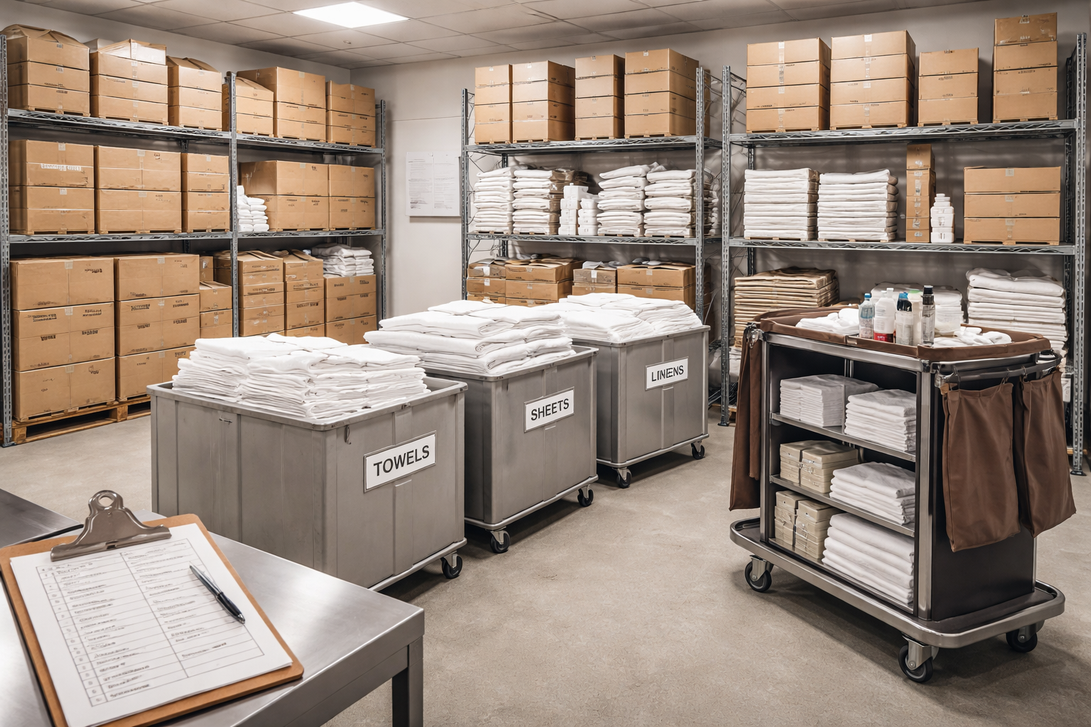
Cost-Saving Tips for Hotels When Buying Supplies in Bulk
Quick Answer
To save money buying hotel supplies in bulk without creating waste or service issues: standardize your core SKUs, buy in case-pack quantities that match real usage, protect storage conditions (especially textiles), negotiate around freight and lead times, and track a simple “true cost” that includes laundry water/energy, labor handling, and replacement rates—not just unit price.
1) Start with standardization: fewer SKUs, fewer surprises
Bulk buying works best when teams aren’t juggling multiple versions of the same item. Standardizing reduces ordering errors, simplifies training, and helps you reorder consistently.
- Choose a core set of room and back-of-house staples (bedding, towels, shower curtains, amenities, cleaning supplies) and keep variations to true brand tiers or property types.
- Document specs for each standard item (size, material, color, pack size) so new buyers or managers can reorder accurately.
- Align with operations: housekeeping and laundry teams should validate that standardized items work with existing carts, storage, and laundry processes.
Hotels4Humanity organizes common purchasing categories across Hotel Room Supplies, including hotel bedding, towels, bathroom supplies, and housekeeping/janitorial items—use those category groupings as a framework for your standard list.
2) Buy by “use rate,” not by “deal size”
The most common bulk-buying mistake is purchasing far beyond what your hotel can consume before items degrade, go out of style, or get damaged in storage.
- Set a reorder point based on average weekly/monthly usage and lead time.
- Match case packs to reality: buying a slightly higher unit cost can be cheaper overall if it avoids expired amenity stock, crushed cartons, or linen discoloration.
- Use “par levels” for textiles to avoid overbuying. (Editorial guidance: many hotels manage linen/towel inventory by a target number of sets per bed/room, then replace on a schedule.)
3) Protect your bulk purchase in storage (especially textiles)
Bulk savings disappear if goods get damaged before they reach a guestroom. This matters most for towels and bedding, where staining, moisture, and dust can force early replacement.
- Rotate inventory (FIFO) so older cartons are issued first.
- Keep textiles wrapped and off the floor to reduce dust and moisture exposure.
- Separate chemicals from linens in storage areas to reduce odor transfer and accidental spills (editorial guidance).
If you’re building a bulk program around key guest-touch items, start with consistent categories like Hotel Bedding and Hotel Towels, then expand once storage and rotation practices are stable.
4) Use “total cost,” not just unit price
A low unit price can cost more if it increases laundry utilities, slows housekeeping workflows, or wears out faster. When comparing bulk options, consider what it costs to use the product at your property.
Example: Laundry-related costs can outweigh price differences
ENERGY STAR notes that ENERGY STAR certified commercial clothes washers are on average 9% more efficient and use about 45% less water than standard models. If your linen program increases wash loads or requires more rewashing (e.g., due to poor soil release or linting), you may be paying more in water and energy than you saved on purchase price.
Source: ENERGY STAR – Commercial Clothes Washers
A simple comparison table for bulk decisions
| Cost factor | What to measure | Why it matters in bulk buys |
|---|---|---|
| Delivered unit cost | Item price + freight / units | Large orders can change freight class, pallet count, and receiving time. |
| Handling & storage | Receiving time, storage space used | Big deliveries add labor and can increase damage risk if space is tight. |
| Laundry impact | Loads/week, rewashes, water/energy | Higher usage drives utility costs; efficient laundry equipment reduces the penalty. |
| Replacement rate | How often items are pulled from service | Cheaper items may need more frequent replenishment, reducing real savings. |
| Operational consistency | Guest complaints, housekeeping feedback | Inconsistent SKUs create service variability and retraining costs. |
5) Negotiate the bulk buy around logistics, not only price
For hotels, “bulk” is as much about predictability as it is about discounts. Keep conversations grounded in operational needs:
- Confirm lead times and backorder plans so you don’t get forced into last-minute substitutions.
- Ask about split shipments (editorial guidance) if storage is limited—sometimes it’s cheaper than paying for damaged or misplaced inventory.
- Standardize pack sizes so receiving and counting are faster for housekeeping and purchasing.
6) Build bulk programs around your highest-volume categories
Not every supply category benefits equally from bulk purchasing. Most hotels see the clearest gains where consumption is steady and specification changes are rare.
- Guestroom textiles: sheets, pillowcases, towels (high usage, frequent laundering).
- Bathroom basics: shower curtains and common accessories (predictable replacement cycles).
- Housekeeping essentials: cleaning supplies and cart accessories (workflow-driven replenishment).
Hotels4Humanity’s category structure reflects these operational groupings, spanning hotel bathroom supplies, towels, bedding, and Housekeeping & Janitorial items within the broader Hotel Room Supplies catalog.
7) Put guardrails in place: quality checks and reorder discipline
Bulk buys can lock you into problems. Add lightweight controls to protect your budget:
- Inspection on receipt (editorial guidance): spot-check cartons for damage, color variance, and labeling accuracy.
- Track issues by lot/date so you can isolate defects and avoid mixing inconsistent stock across floors or buildings.
- Create a reorder cadence (monthly/quarterly) tied to occupancy and seasonality—avoid reactive ordering that breaks standardization.
Bulk buying checklist (printable)
- Do we have one approved spec per core item?
- Is our order quantity based on actual consumption and lead time?
- Do we have storage space that protects linens and chemicals separately?
- Did we calculate delivered cost (including freight) vs. unit price?
- Did we account for laundry water/energy impacts and rewashes?
- Do we have a receiving/inspection process to prevent large-scale issues?
Sources: Hotels4Humanity category and catalog references from Hotel Room Supplies and Housekeeping & Janitorial Supplies for Hotels. Laundry efficiency figures from ENERGY STAR – Commercial Clothes Washers (ENERGY STAR certified commercial clothes washers are on average 9% more efficient and use about 45% less water than standard models).

About the author
hotels4humanity
Practical purchasing guidance for hospitality teams choosing dependable supplies for better guest stays.
Was this guide helpful?
Your feedback helps us improve future operator guides.
Related posts
Disposable vs. Reusable Hotel Slippers: A Bulk Purchasing Guide
Sep 28th 2026
Hotel Bed Frame Buying Guide: Fit, Support, and Installation Checklist
Sep 15th 2026

What Mattresses Do Hotels Use? A Commercial Buying Guide
Sep 7th 2026

Essential Hotel Amenities for Business Travelers: An Operator's Checklist
Aug 31st 2026