Hotel Laundry
Hotel Laundry Supplies Checklist for Housekeeping Teams
What you'll learn
Quick Answer
A strong hotel laundry supplies checklist should cover: (1) linen and towel SKUs you stock, (2) how you collect and sort soiled textiles, (3) storage and par levels, (4) washer efficiency and load practices, and (5) rewash controls that reduce waste and guest-impacting shortages. Use this article as a practical checklist for housekeeping leads, laundry attendants, and buyers.
Why a laundry supplies checklist matters (beyond “having enough”)
Laundry is a throughput system: what comes off rooms must be collected, sorted, processed, stored, and returned to service without bottlenecks. A checklist helps you prevent common failure points—missing cart accessories, inconsistent sorting, over-ordering one SKU while another runs short, and rewash loops caused by stains, odors, or misloads.
Core laundry supplies checklist (by function)
1) Linens and bedding (what you actually process)
Standardize SKUs first; the more variation, the harder it is to hold consistent par and wash performance. Hotels4Humanity’s Hotel Bedding category shows the typical breadth buyers manage—sheets, pillowcases, duvet covers/inserts, mattress pads, and protectors—so build your checklist around what you truly stock and issue.
- Bed sheets & linen: top sheets/flat sheets, fitted sheets, pillowcases (document size and fabric type)
- Protective layers: pillow protectors, mattress pads (reduce stains and extend linen life)
- Duvet/comforter program: duvet covers, duvet inserts/filled blankets, coverlets/bedspreads (define what is laundered in-house vs. sent out)
- Blankets: cotton or polyester/plush/fleece options (list which are guest-facing and how often they’re laundered)
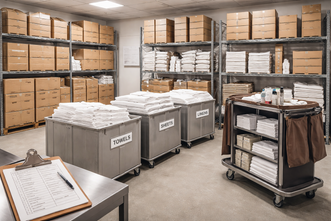
2) Towels and bath textiles
Align towel types to your room set and amenities so housekeeping issues consistent quantities. Hotels4Humanity’s Hotel Towels selection highlights the common categories you’ll want on your checklist.
- Bath towels (including bath & spa towel programs)
- Hand towels
- Washcloths
- Pool / beach towels (if applicable; often a separate sort stream)
- Gym towels (if applicable)
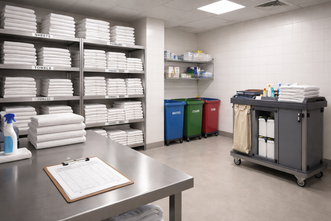
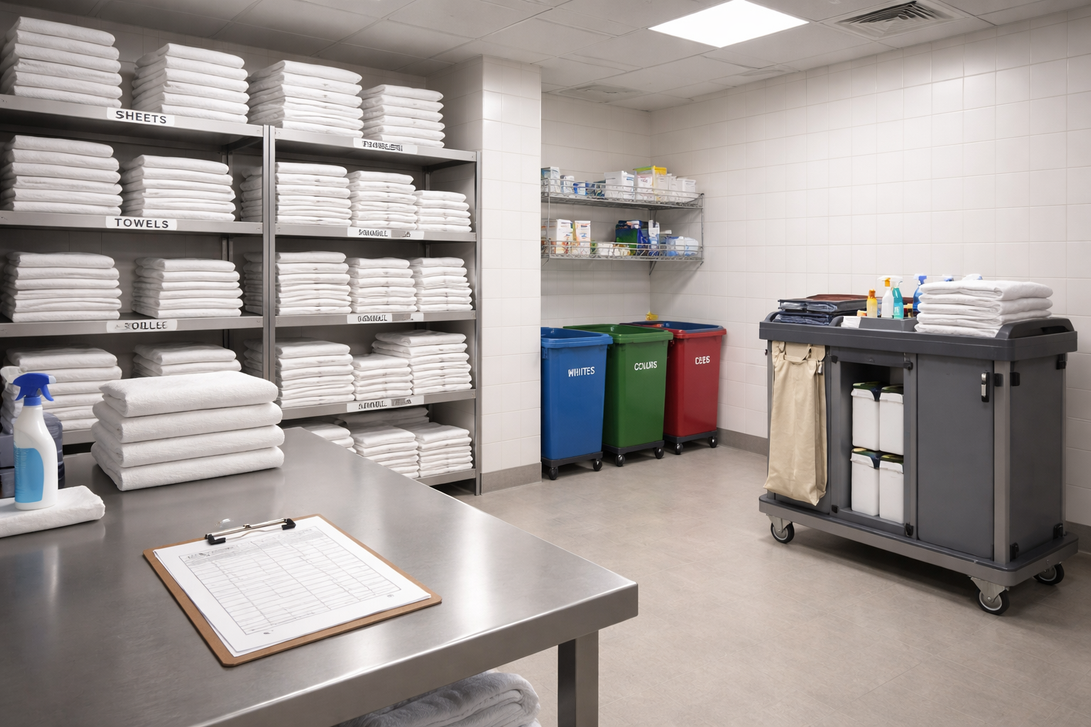
3) Collection, carts, and transport (preventing cross-contamination and loss)
Your laundry room can only run as smoothly as the “front end” allows. If attendants don’t have the right cart setup, textiles get mixed, dragged, or stored improperly, increasing rewash and replacement.
- Housekeeping carts sized for your corridors/elevators
- Cart accessories (e.g., bag supports, shelving inserts, holders) appropriate to your workflow
- Soiled linen bags (separate bags for different streams when needed, such as pool towels)
- Labels/signage for sorting rules (simple and visual)
- Bins or hampers for staging (avoid placing linens on the floor)
For a broader view of operational supplies that support this workflow, see Housekeeping and Janitorial Supplies.
4) Sorting and stain control supplies (reducing rewash)
Many laundry disruptions trace back to inconsistent sorting and delayed stain treatment. Your checklist should explicitly define what “sorted” means for your property (by color, soil level, linen type, or area of use).
- Sort zone supplies: color-coded bins, tags, or rack positions
- Stain treatment tools: spotting bottles, brushes, towels/rags dedicated to spotting
- Spotting station protection: gloves and splash protection as required by your chemical program
- Reject/repair bin: for torn items, heavy stains, or items to be removed from service
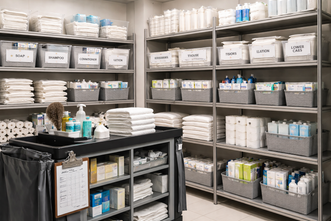
5) Storage and staging supplies (clean linen protection)
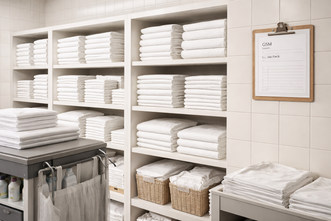
Clean linen storage is where “we washed it” becomes “we can use it.” Stock the basics so clean items stay clean, countable, and accessible.
- Shelving that supports FIFO rotation
- Protective covers for bulk stacks where needed
- Inventory labels by SKU and size (especially for sheets and pillowcases)
- Dedicated staging area for outbound distribution to floors
Par levels: the minimum math every checklist should include
Even without perfect forecasting, you can manage par levels consistently. Add a “par section” to your checklist for each major SKU (bath towels, king fitted sheets, etc.). Use these fields:
- SKU name + size
- Room set standard (how many per room)
- Par target (e.g., 3-par: in room, in laundry, on shelf)
- Minimum on-hand trigger (reorder point)
- Expected weekly loss/reject rate (based on your history)
Washer efficiency: what to ask for and how to operationalize it
When you’re evaluating equipment—or benchmarking an on-premise laundry—use third-party efficiency context. ENERGY STAR notes that ENERGY STAR certified commercial clothes washers are on average 9% more efficient and use about 45% less water than standard models. This is a useful reference point when comparing models and building a utility-cost business case.
Source: ENERGY STAR Commercial Clothes Washers
Operational checklist items that protect efficiency (editorial guidance)
- Load discipline: define what “full load” means by machine size and linen type (avoid chronic under-loading that wastes water/energy)
- Sort accuracy: prevent heavy-soil items from contaminating light-soil loads, which can drive rewash
- Downtime kit: basic spares or contacts so a single failure doesn’t halt production
Rewash control: checklist fields to track the hidden cost
Rewash consumes labor, water, and linen life—and it can create shortages that show up as guest-facing problems (e.g., delayed room turns). Add a simple rewash log to your checklist process.
Rewash log (simple template)
| Item type | Reason (circle) | Shift | Action taken |
|---|---|---|---|
| Sheets / Pillowcases | Stain • Odor • Still damp • Mixed load • Other | AM / PM | Spot • Re-sort • Adjust cycle • Remove from service |
| Bath towels | Stain • Odor • Lint • Other | AM / PM | Spot • Re-sort • Adjust cycle • Remove from service |
Put it together: a one-page hotel laundry supplies checklist
Use this as your printable master checklist (edit to your property and brand standards):
- Textiles in scope
- Sheets (sizes: ____)
- Pillowcases (sizes: ____)
- Pillow protectors (yes/no; quantity: ____)
- Mattress pads (sizes: ____)
- Duvet covers/inserts or comforters (program notes: ____)
- Bath towels / hand towels / washcloths (room set: ____)
- Pool/beach towels (if applicable; par: ____)
- Collection & transport
- Housekeeping carts available and in service
- Cart accessories installed and functional
- Soiled linen bags stocked (by type/stream)
- Sort signage posted and readable
- Sorting & stain control
- Bins/hamper positions labeled
- Spotting supplies stocked and organized
- Reject/repair bin present and used
- Storage & par management
- Clean shelves labeled by SKU and size
- Par targets documented per SKU
- Reorder triggers defined and monitored
- FIFO rotation practiced
- Efficiency & quality controls
- Washer model/size list maintained (for capacity planning)
- Load discipline guidelines posted
- Rewash log used daily and reviewed weekly
Where to standardize purchases
If you’re tightening consistency across rooms or planning a refresh, standardizing your textile categories is a practical first step. Start with:
- Hotel Bedding for sheets, pillowcases, protectors, and related bed textiles
- Hotel Towels for bath, hand, washcloth, and specialty towel programs
- Housekeeping and Janitorial Supplies for operational items that support collection, staging, and daily execution
Sources
- Hotels4Humanity. Hotel Bedding Supply (category reference for bedding/linen items).
- Hotels4Humanity. Hotel Towels (category reference for towel types).
- ENERGY STAR. Commercial Clothes Washers (efficiency and water-use comparison statement).

About the author
hotels4humanity
Practical purchasing guidance for hospitality teams choosing dependable supplies for better guest stays.
Was this guide helpful?
Your feedback helps us improve future operator guides.