Guest Amenities
Hotel Coffee Maker Buying Guide for Guest Rooms
What you'll learn
Choosing a guest-room coffee maker is not about finding one machine that is best for every hotel. The practical choice is the model that fits the room, works with the property’s supply program, is simple for guests to use, and can be inspected and replaced consistently.
Quick Answer
Compare guest-room coffee makers in this order: brew format, complete station footprint, guest steps, consumables, model-specific cleaning instructions, electrical requirements, and replacement planning. Before approving a model, review its current manual, confirm that its intended setting matches the property’s planned use, and search the exact brand and model number in the CPSC recalls and product-safety warnings database.
Start With the Coffee Program
Define the room’s coffee service before comparing machines. Hotels4Humanity’s hotel coffee maker guide identifies single-serve, pod-based, drip, and programmable machines as formats to compare. The category currently should be used as buying guidance rather than as proof that a particular model is available.
Ask these questions:
- How many servings should a guest be able to prepare at one time?
- Which coffee or tea format will the property stock?
- Will filters, pods, packets, cups, lids, stirrers, and condiments be available consistently?
- How many steps will a first-time guest need to follow?
- Will one model serve most rooms, or do some room types need a different setup?
- What condition will require staff to remove a unit from service?
Keep guest-room machines separate from higher-capacity breakfast-area, lobby, or service-space equipment. Those applications may have different capacity, plumbing, electrical, and energy-management needs.
Measure the Complete Station
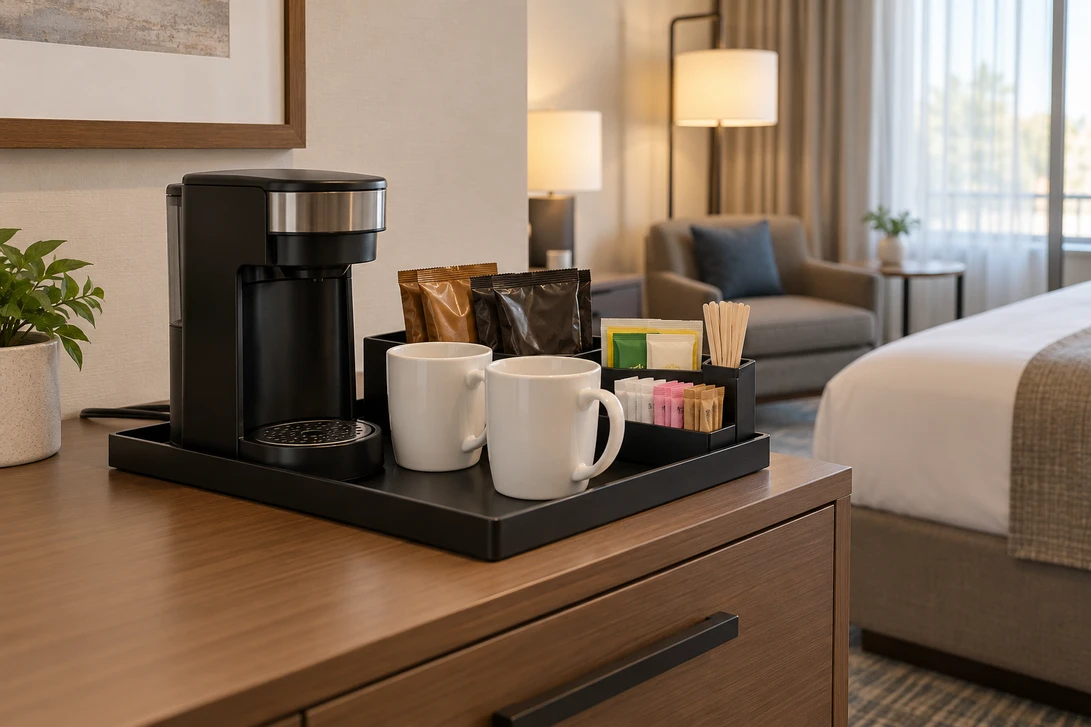
A brewer may fit on the furniture while the complete coffee station does not. Measure the usable surface for the brewer, cups, coffee and condiment packets, tray edges, water-filling access, control access, cord routing, and the space a guest needs to prepare a drink.
For example, one Hotels4Humanity coffee amenity tray listing describes a layout for a four-cup coffee maker, two cups, and a coffee-and-condiment package. That is not a universal layout, but it shows why the complete station should be planned together. Verify the listing’s current specifications and case quantity before ordering.
Room-Setup Checklist
- Measure the usable surface and the clearance needed to fill and operate the machine.
- Confirm that the tray or organizer fits the intended cups and supply packets.
- Check whether the power cord reaches the approved outlet without crossing a guest-use area.
- Leave room for housekeeping to inspect, clean, and restock the station.
- Record the approved placement with a room-standard photo or diagram.
Plan the station alongside other hotel room supplies so placement, replenishment, and room inspections follow one practical workflow.
Choose a Format the Property Can Replenish
| Decision area | What to compare | Question for the property |
|---|---|---|
| Brew format | Single-serve, pod-based, small drip, or programmable | Which format matches the intended room experience and approved supply program? |
| Capacity | The exact model’s stated serving size, carafe size, or reservoir design | Does it provide the intended number of servings without taking more space than needed? |
| Consumables | Coffee format, filters when required, cups, lids, sweeteners, and stirrers | Can every room be restocked with the same approved items? |
| Guest use | Water-fill steps, control layout, and instructions | Can a first-time guest understand the setup? |
| Replacement | Spare units, an approved substitute, and compatible supplies | What happens when a unit is damaged, missing, or removed from service? |
Where room designs allow it, a consistent model can make placement, staff training, turnover inspections, and replacement ordering more manageable. This is an operating choice, not a substitute for checking each model’s specifications. For broader room-readiness planning, see the business-traveler amenities checklist.
Confirm Electrical Fit and Intended Use
Before a property-wide rollout, have the appropriate property staff review the exact model’s rating label and current manual. Confirm voltage, amperage, wattage, grounding instructions, cord-placement limits, circuit capacity, and whether the manufacturer identifies the appliance for the intended setting.
The need for model-level review is easy to see in the BUNN My Café use-and-care manual. That particular manual lists 120 V, 11.7 A, 1,400 W, a grounded cord, and a 4-to-14-ounce brew range. It also says the appliance is UL listed for household use only. This is an illustration of model-specific requirements—not a recommendation of that machine for hotel use and not a specification that should be copied to another brewer.
Keep the approved model number, rating information, and current manual with the property’s purchasing and operations record.
Build Model-Specific Cleaning Into Room Turnover
Use the current manual for the exact model when creating cleaning and maintenance instructions. Do not apply one descaling recipe, chemical, water instruction, or fixed interval to every coffee maker. Manuals can differ on removable parts, approved cleaners, flushing steps, mineral buildup, cooling time, and electrical precautions.
The BUNN example, for instance, gives its own instructions for routine cleaning and mineral-deposit removal. Those directions belong to that model only. A different coffee maker may require a different process.
What the Property Should Define
- Who checks the station during room turnover.
- Which supplies are replaced or replenished.
- What visible damage, missing part, leak, or operating problem takes a unit out of service.
- Where the current manual and approved cleaning instructions are stored.
- Who performs manual-directed maintenance and how completion is recorded.
This separates the routine room check from maintenance that requires the model manual or trained property staff.
Consider Energy Features in the Right Setting
For qualifying commercial brewers used in breakfast, lobby, or service areas, the U.S. Department of Energy says ENERGY STAR-qualified commercial coffee brewers include an energy-save mode. DOE also recommends preventing heating elements from operating during inactive hours. Its guidance covers defined commercial-brewer categories and excludes several other machine types, so apply it only after checking the actual equipment and operating location. It is not a universal guest-room rule.
Plan for Replacement and Recall Checks
Decide before rollout whether the property will keep spare units, approve a substitute model, or replace equipment by room group. Record the model number, coffee format, station layout, compatible consumables, and manual location. If a substitute is introduced, repeat the fit, supply, electrical, cleaning, and intended-use checks instead of assuming it is interchangeable.
Before ordering, redeploying, or retaining replacement inventory, search the exact brand and model number in the CPSC recall database. CPSC states that recall data is updated weekly and remedy information may change daily. A search that returns no match is not proof that a product is safe. If a result matches the exact model, review the notice and follow its current remedy.
Final Buying Checklist
As an operating standard, approve a guest-room coffee maker only after the property can answer yes to these questions:
- Does the brew format match the planned room program?
- Does the complete station fit the approved location?
- Can guests operate it with clear, simple steps?
- Can the property reliably replenish all required supplies?
- Has the exact model’s intended setting and electrical fit been confirmed?
- Does its current manual support the planned cleaning workflow?
- Is there a documented process for damaged units, replacements, and recall checks?
This keeps the buying decision focused on dependable room operations: a station guests can understand, staff can reset, and purchasing can replace consistently.
Sources
- Hotels4Humanity: Hotel Coffee Makers for Guest Rooms
- Hotels4Humanity: Hotel Room Supplies
- Hotels4Humanity: Black Coffee Amenity Tray
- BUNN: My Café Use and Care Manual
- U.S. Consumer Product Safety Commission: Recalls & Product Safety Warnings
- U.S. Department of Energy: Purchasing Energy-Efficient Commercial Coffee Brewers

About the author
hotels4humanity
Practical purchasing guidance for hospitality teams choosing dependable supplies for better guest stays.
Was this guide helpful?
Your feedback helps us improve future operator guides.