Hotel Amenities
Disposable vs. Reusable Hotel Slippers: A Bulk Purchasing Guide
What you'll learn
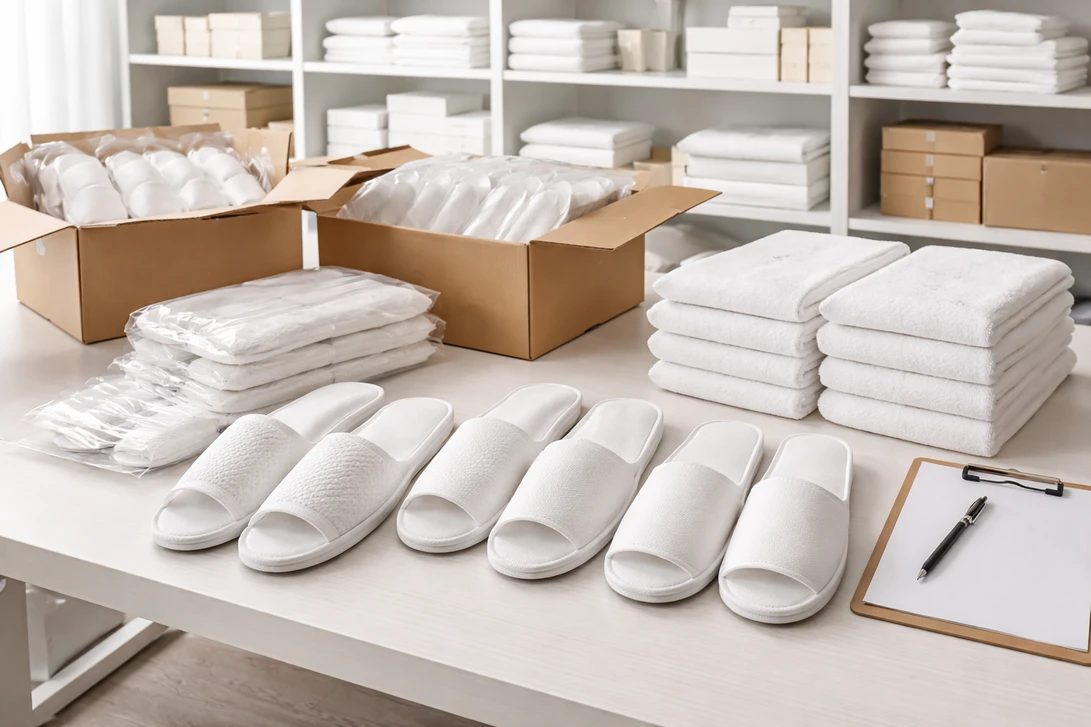
Hotel slipper programs are not one-size-fits-all. The right approach depends on how pairs will be issued, whether the selected product is intended for reuse, what laundering and inspection process the property can support, and how much inventory and storage the operation can manage.
Quick Answer
Choose a single-guest-use program when each issued pair will be retired after the stay and your priority is simple room staging and replenishment. Consider reusable slippers only when the exact product is intended for repeated laundering and your property has a documented process for collection, washing, drying, inspection, clean storage, and retirement.
Do not assume that an individually packaged slipper is disposable or that a machine-washable slipper is automatically suitable for commercial reuse. Confirm the designation, materials, care information, packaging, size, sole construction, case pack, and intended use for the exact option being ordered. Hotels4Humanity's hotel slippers in bulk category identifies material, size, packaging, and disposable-versus-reusable status as key comparison points.
Disposable vs. Reusable Hotel Slippers at a Glance
| Buying factor | Single-guest-use program | Reusable program |
|---|---|---|
| Guest presentation | An unused pair can be staged in the room or issued on request. Individual packaging may simplify presentation, but packaging alone does not establish that a slipper is disposable. | Each pair must meet the property's guest-ready standard after collection, processing, inspection, and storage. |
| Operational work | Receiving, stocking, staging, replenishment, inventory counting, and post-use waste handling. | Collection, laundry processing, inspection, sorting, clean storage, inventory control, and retirement decisions. |
| Cost model | Recurring cost based on the number of pairs issued, delivered cost, storage, handling, and disposal. | Purchase cost plus processing, labor, losses, premature damage, laundry turnaround, and replacement inventory. |
| Operational fit | Properties that want a straightforward fresh-pair workflow without processing footwear after use. | Properties that have verified the product and can consistently support the required laundry and quality-control process. |
When a Single-Guest-Use Program Makes Sense
A single-guest-use program may be practical when housekeeping needs to stage an unused pair quickly and the property does not have a validated process for laundering and redeploying slippers. It can also simplify basic inventory tracking because pairs are received by case and issued under a defined room, guest, or spa policy.
Use the supplier's description for the exact product. Terms such as disposable, single-use, individually bagged, and take-home are not automatically interchangeable.
Questions to ask before ordering
- Will pairs be placed in every room, limited to selected room types, included in spa packages, or provided on request?
- Has the supplier identified the exact option as disposable or intended for one guest?
- Does the presentation require individual packaging, a reusable bag, or bulk-packed pairs?
- Does one-size-fits-most provide acceptable coverage, or are multiple sizes needed?
- How many pairs fit in the receiving area, central storeroom, and housekeeping closets?
- What stock level will cover the supplier lead time and a reasonable demand buffer?
An individual bag can support an unused-pair presentation. It does not, by itself, substantiate antimicrobial performance, hygiene superiority, or suitability for a particular floor or use area.
When Reusable Hotel Slippers Make Sense
Reusable slippers are a system decision rather than simply a fabric choice. A product described as machine washable may still be a poor fit if its upper, foam, stitching, adhesive, backing, or sole cannot withstand the property's actual wash-and-dry process.
Some options on the current Kartri bath slipper product page have variant-specific packaging, sole, pack-count, and washability descriptions. Buyers should confirm the selected option rather than applying one variant's specifications to the entire product family.
The CDC's laundry and bedding guidance applies to healthcare facilities, not ordinary hotel slipper programs. Its process principles are nevertheless useful as a reference: follow manufacturer instructions, control the handling of used and processed textiles, and protect clean items from recontamination. The following checklist is editorial operating guidance, not a statement of universal hotel regulation.
Reusable-program readiness checklist
- Obtain written care information for the exact slipper option.
- Confirm compatibility with the actual wash chemistry, cycle, temperature, extraction, and drying process.
- Ask the laundry vendor whether it will accept and separately track slippers.
- Define where used pairs are collected and how they are kept apart from processed inventory.
- Provide protected clean storage and enough inventory to cover laundry turnaround.
- Set a guest-ready inspection standard covering visible soil, staining, odor, torn uppers, damaged soles, delamination, deformation, and other unacceptable wear.
- Run a controlled trial through the real on-premise or outsourced laundry process before placing a property-wide order.
- Record successful uses, rewashes, damage, losses, processing time, and retirement reasons during the trial.
Retire any pair that cannot be processed according to its care information or no longer meets the property's documented guest-ready standard.
Compare Materials, Toe Styles, Soles, Sizes, and Packaging
Construction affects fit, presentation, storage, and compatibility with the intended workflow. Compare specifications at the exact option or SKU level; product-family names and photos may not capture every variant difference.
- Upper material: Obtain the supplier's exact material description instead of relying on appearance or a category-level summary.
- Toe style: Open-toe and closed-toe designs provide different levels of coverage and may fit guests differently.
- Sole construction: Confirm the sole material, thickness, attachment method, and care limitations for the selected option.
- Sizing: Test one-size-fits-most products with a representative user group and determine whether additional size options are required.
- Packaging: Confirm whether pairs are individually bagged, supplied in another presentation bag, or bulk-packed inside the case.
- Case pack: Verify the number of pairs in the exact option instead of relying on the product-family title.
- Use area: Match the product to the intended guestroom, spa, or other controlled setting. Do not infer wet-floor suitability from tread appearance or sole material alone.
- Customization: If monogramming or other branding is required, confirm availability, minimum quantities, lead time, placement, care limitations, and return terms in writing.
Do not describe a slipper as non-slip, slip-resistant, antimicrobial, medical-grade, biodegradable, or compostable unless documentation supports that exact claim for the exact product. Packaging or an unused-pair presentation does not turn a standard slipper into an infection-control product.
How to Compare Total Cost
Unit price is only one input. Define all costs on the same basis before comparing programs.
Single-guest-use estimate
Estimated cost per occupied room =
issued pairs per occupied room ×
(purchase price per pair
+ allocated inbound freight per pair
+ allocated storage and handling per pair
+ allocated disposal cost per pair)
Use the actual issue rate. A program that provides slippers only on request should be modeled with measured request data rather than an assumption that every occupied room receives a pair.
Reusable trial-cohort estimate
Cost per successful guest use =
(test-cohort purchase cost
+ collection and processing costs
+ laundry or vendor charges
+ inspection and repacking costs
+ costs from loss or premature retirement)
÷ successful guest uses delivered during the trial
A successful guest use means that a pair was issued in guest-ready condition. Record failed inspections, rewashes, losses, and early retirements rather than assuming a number of turns in advance.
Do not assume reusable slippers will automatically cost less. Likewise, do not declare either program environmentally preferable without product-specific information about materials, packaging, transport, disposal, laundry inputs, and achieved reuse. The FTC advises against broad, unqualified environmental claims and requires appropriate evidence for claims such as biodegradable or compostable. See the FTC's summary of the Green Guides.
Plan the Bulk Order
Base the order on the issue policy and replenishment window, not room count alone. A property that issues slippers on request will have a different requirement from one that places two pairs in every occupied room.
Single-guest-use planning formula
Forecasted pairs required =
forecasted occupied rooms or eligible guests
× issue rate
× pairs per issue
+ safety stock
Divide the result by the confirmed case-pack quantity and round up to a whole case. Select the safety stock from the property's measured demand variability, supplier lead time, receiving schedule, and available storage rather than using a universal percentage.
Reusable inventory planning
Reusable inventory should account for pairs expected to be in guest use, pairs in collection or laundry processing, clean reserve inventory, and a trial-based allowance for loss and premature retirement. There is no universal slipper par level because turnaround time, issue volume, processing frequency, and usable life vary by property and product.
Bulk-order worksheet
- Eligible occupied rooms, guests, or appointments per ordering period
- Measured or planned issue rate
- Pairs per issue
- Exact case-pack quantity
- Delivered cost and supplier lead time
- Safety-stock quantity
- Receiving and storage capacity
- Packaging and presentation requirements
- For reusable programs: laundry turnaround, trial results, processing cost, achieved uses, and replacement reserve
Order samples before changing construction, packaging, sizing, or a reusable workflow. Housekeeping, laundry, spa operations, receiving, and purchasing should review the trial results before the product is standardized.
Materials, Care Information, and Product Claims
U.S. labeling requirements depend on the product and transaction. FTC guidance states that slippers and other outer footwear are generally outside the Textile Act's labeling requirements, while slippers containing or represented as containing wool are covered by the Wool Rules. The FTC's Care Labeling Rule also excludes footwear from its definition of textile wearing apparel.
Those exclusions do not make supplier documentation unnecessary. Buyers considering a reusable program should still obtain accurate material and care information for operational reasons. Properties that import, private-label, make wool or environmental claims, or resell slippers to consumers should obtain compliance guidance for the exact product and sales arrangement. This article is purchasing guidance, not legal advice.
Antimicrobial language also requires particular care. The EPA explains that treated products generally cannot make public-health claims merely because an antimicrobial treatment protects the article itself. Do not convert a supplier's preservation claim into a claim that slippers protect guests from germs or disease.
Choose the Program Your Operation Can Support
The best slipper program is one the property can operate consistently. A single-guest-use program can provide a straightforward unused-pair workflow. A reusable program may be appropriate when the exact slipper has suitable care information and the property has validated its laundry, inspection, storage, inventory, and retirement process.
Review available hotel slippers in bulk, then coordinate the selected program with robes, towels, amenities, and other hotel bathroom supplies.
Sources

About the author
hotels4humanity
Practical purchasing guidance for hospitality teams choosing dependable supplies for better guest stays.
Was this guide helpful?
Your feedback helps us improve future operator guides.
Related posts
Disposable vs. Reusable Hotel Slippers: A Bulk Purchasing Guide
Sep 28th 2026
Hotel Bed Frame Buying Guide: Fit, Support, and Installation Checklist
Sep 15th 2026
What Mattresses Do Hotels Use? A Commercial Buying Guide
Sep 7th 2026

Essential Hotel Amenities for Business Travelers: An Operator's Checklist
Aug 31st 2026