Business Travel
Essential Hotel Amenities for Business Travelers: An Operator's Checklist
What you'll learn
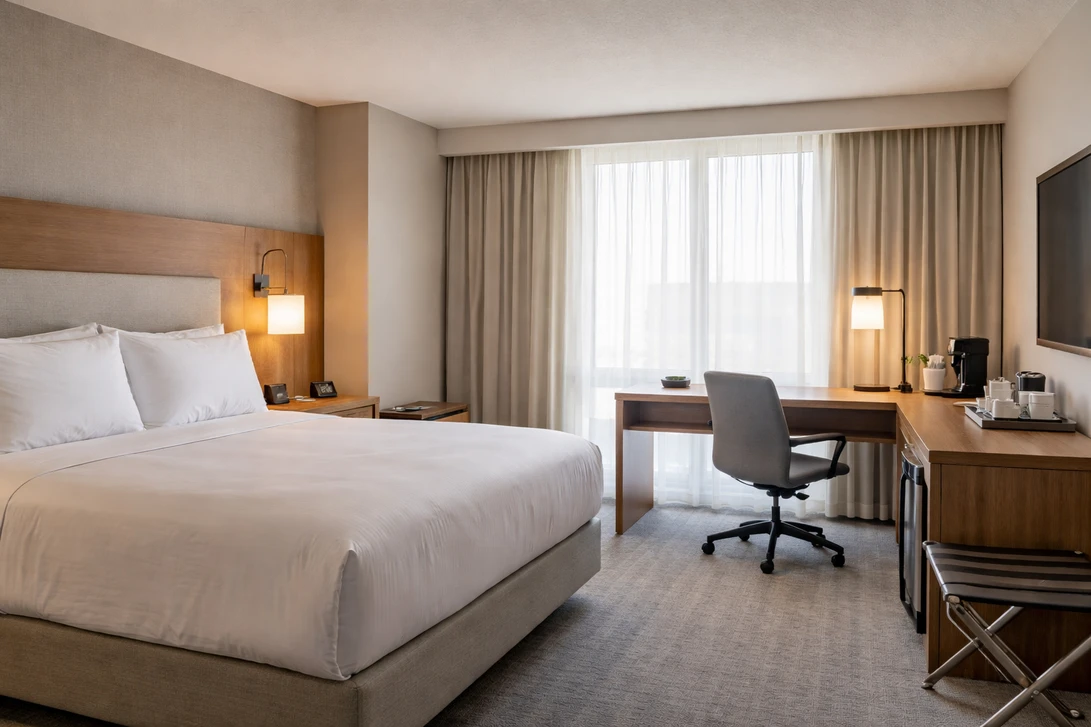
For hotels that serve work trips, the most useful amenity program is not a collection of novelty upgrades. It is a set of room-readiness and service controls that can help guests prepare for meetings, keep a schedule, and reset between workdays.
In BCD Travel's global survey of 1,035 business travelers, conducted in May 2025, location (77%), employer policy (56%), and price (53%) were selected more often among the top three accommodation-choice factors than hotel amenities (21%). Amenities therefore should not be treated as a substitute for the right location, corporate-program eligibility, or rate structure. They are the operational layer that shapes the stay after a guest arrives. Read the BCD Travel survey report.
Quick Answer: What Should Hotels Prioritize for Business Travelers?
As a practical starting point, prioritize features that reduce common work-trip friction: an easy connection process for guest Wi-Fi, a clean and usable work surface, convenient power access, working task lighting, clearly explained food and coffee options, sleep-ready room basics, and accurate service information.
Add longer-stay features such as laundry access, food storage, and additional replenishment only when the property's demand mix supports them. Project teams, relocation guests, training groups, crews, and multiweek assignments may justify a different amenity tier than short business stays.
Build for Work-Trip Friction, Not a Generic Guest Profile
Business guests have different schedules, trip lengths, employer policies, and room-use patterns. Operators should not assume that every traveler wants the same setup. Instead, evaluate each amenity with three questions:
- Does it make it easier for a guest to work or prepare for the day?
- Does it help the guest keep a schedule?
- Can the property deliver, inspect, replenish, and describe it consistently?
BCD's survey found that Wi-Fi (88%) and breakfast (80%) were the most commonly used hotel services among respondents. Restaurant, cafe, or bar service (61%), early check-in or late check-out (47%), parking (45%), and gym access (41%) were also used by portions of the sample. Slow Wi-Fi was selected by 51% as a source of friction during hotel stays.
The same survey found that 77% of respondents preferred chain hotels with familiar service standards, while 73% said they repeatedly stayed at the same hotel when returning to a destination. Those findings do not prove that any single amenity causes repeat business, but they support an operator focus on predictable delivery rather than novelty for its own sake.
Priority 1: Room-Readiness Essentials to Inspect Every Turnover
The following items are operator recommendations rather than universal traveler requirements. They belong near the top of the inspection list because they affect whether the assigned room is complete and ready to use.
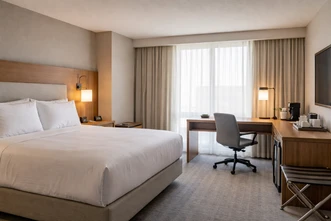
Workspace, Lighting, and Charging
- Clear work surface: Confirm that the desk or table is stable, clean, uncluttered, and usable for a laptop and basic work materials.
- Working task lighting: Check lamps, switches, and bulbs under the property's room-inspection procedure.
- Reachable power: Provide practical charging access near the work area and bed. Inspect outlets and charging equipment for operation and visible damage, and remove damaged equipment from service under property procedures.
- Current connection instructions: Place Wi-Fi access and support information where guests can find it without first calling the front desk.
For replacement planning, standardizing hotel charging stations across comparable room types may simplify placement, inspection, and replacement for housekeeping and maintenance teams.
Coffee, Garment Care, and Arrival Setup
- Complete coffee setup: If the property offers in-room coffee, verify that the equipment, cups, condiments, and replenishment items are present and orderly.
- Iron and ironing board: If offered, inspect the equipment for cleanliness, visible damage, proper placement, and operation according to property and manufacturer procedures.
- Available hangers: Set an internal stocking standard appropriate for the room type and typical stay pattern.
- Clean luggage rack: Check that the rack is clean, stable, and ready to use.
A consistent hotel coffee maker program may make training, replacement ordering, and turnover inspections more manageable when in-room coffee is part of the property offering.
Sleep-Ready Room Basics
- Test climate controls according to property procedures.
- Inspect blackout treatments, locks, clocks, and other room basics for proper operation.
- Remove damaged, mismatched, stained, or depleted room items before releasing the room.
- Confirm that bedding, towels, and bathroom supplies meet the property's established presentation and replenishment standards.
The objective is not to claim that every guest uses every item. It is to make the assigned room complete, orderly, and predictable at arrival.
Priority 2: Property-Level Services to Validate and Communicate
Service descriptions, posted hours, booking listings, and staff explanations should match current operations. If a service is limited, temporarily unavailable, subject to a fee, or offered only on request, communicate that information before it becomes a guest surprise.
| Service Area | Operator Check | What to Communicate Clearly |
|---|---|---|
| Wi-Fi | Test the guest connection process and practical coverage in representative rooms and work areas; keep support instructions current. | Access process, support contact, charges if any, and known service limitations. |
| Breakfast and coffee | Verify hours, format, inclusions, replenishment, and grab-and-go availability. | Start and end times, location, rate inclusions, and changes to normal service. |
| Food options | Confirm restaurant, cafe, bar, vending, market, and room-service availability. | Actual operating hours, ordering procedures, and practical nearby-food guidance where appropriate. |
| Arrival and departure | Align front-desk language with the property's actual early-arrival and late-departure process. | Availability conditions, applicable fees, and luggage-storage procedures. |
| Parking and transportation | Keep directions, pickup areas, fees, schedules, and access procedures current. | Parking details, current transportation status, and ride-share pickup guidance. |
| Fitness access | Check hours, entry procedures, equipment condition, and temporary closures. | Current access details, age or supervision rules where applicable, and closure notices. |
Handle Wi-Fi Claims Carefully
Wi-Fi should be treated as a priority service, but operators should describe it accurately rather than make unsupported promises about speed, bandwidth, privacy, security, or uninterrupted performance. Test the guest connection journey, document the property's support process, and make sure booking listings reflect actual availability.
The U.S. Federal Trade Commission says that widespread website encryption makes connecting through public Wi-Fi usually safe and recommends protective practices such as updated software, strong passwords, and two-factor authentication. That general consumer guidance does not evaluate or validate the configuration, security, speed, or privacy of an individual hotel network. Review the FTC's public Wi-Fi guidance.
Avoid descriptions such as “secure Wi-Fi,” “guaranteed bandwidth,” or “video-call-ready” unless the property has current technical evidence and operating controls that substantiate the specific claim.
Priority 3: Extended-Stay and Project-Travel Add-Ons
BCD found that, among surveyed respondents who used apartments for business travel, 46% selected that apartments work better for long visits. The report does not establish kitchenettes, laundry, or suite-style layouts as universal business-traveler requirements.
For properties that regularly serve extended assignments, crews, relocation stays, medical travel, training programs, or recurring project teams, operators may consider a separate longer-stay amenity tier:
- Refrigerator, microwave, kitchenette, or clearly explained food-storage options.
- Guest laundry access or a transparent laundry and dry-cleaning process.
- Additional hangers, closet capacity, and luggage-storage options.
- A documented replenishment cadence for towels, coffee, and bathroom consumables.
- Workspace and seating that remain usable when a guest spends more time in the room.
Keep these additions separate from the every-room baseline in the purchasing plan. This allows capital and inventory decisions to follow the property's actual demand rather than treating every room as an extended-stay unit.
How to Create a Business-Ready Procurement Plan
Standardize High-Touch Items First
Begin with products that guests and staff encounter frequently, such as charging equipment, coffee setups, luggage racks, ironing supplies, bedding, towels, and bathroom replenishment items. Where room designs allow it, standardization can make placement, inspection, replacement, and staff training more manageable.
Buy for Reset and Replacement
Opening-day appearance is only one purchasing consideration. Evaluate whether each item is practical to clean, store, inspect, replace, and reorder. Maintain an approved replacement or substitution process for fast-moving and damage-prone items so a missing component does not leave a room incomplete.
Set Par Levels by Property Use
Set internal par levels using property-specific information such as room count, occupancy patterns, turnover frequency, laundry cycles, lead times, and observed damage or loss. Review those levels after high-demand periods and when the room design, service model, supplier availability, or guest mix changes.
Separate Room Basics From Optional Upgrades
Maintain one purchasing list for the property's every-room baseline and another for room-type, package, or extended-stay additions. This can help purchasing teams preserve a consistent minimum while tailoring suites, premium rooms, and project-travel inventory.
Test Before Calling an Amenity Available
Confirm that staff can locate, operate, replenish, and explain an amenity before adding it to booking listings or sales materials. For services with limited hours or conditional availability, include those conditions wherever guests are likely to make a decision.
For a broad procurement starting point, explore Hotel Room Supplies, including coffee makers, charging stations, luggage racks, ironing supplies, room accessories, bedding, towels, bathroom supplies, and housekeeping-ready replacements.
Final Pre-Arrival Audit for Business-Ready Rooms
- ☐ Wi-Fi access and support instructions are visible, current, and understandable.
- ☐ The desk or table, chair, power access, and task lighting are clean and functional.
- ☐ Coffee equipment and supplies are complete if offered.
- ☐ The iron, ironing board, hangers, and luggage rack are present and ready if offered.
- ☐ Climate controls, blackout treatments, locks, clocks, and other room basics have been checked under property procedures.
- ☐ Bedding, towels, and bathroom supplies are complete and meet presentation standards.
- ☐ Breakfast, food-service, parking, transportation, fitness, and arrival or departure information reflects current operations.
- ☐ Staff know how to route guests to the appropriate support contact, including after hours where applicable.
- ☐ Booking listings and sales materials do not overstate amenity availability or network performance.
This checklist addresses amenity readiness and service communication. It is not an accessibility or network-security compliance audit; apply the property's applicable legal, technical, brand, and professional-review requirements separately.
A business-ready room does not need to be overloaded with amenities. It needs to be complete, easy to use, accurately represented, and consistently reset. Focusing on those operating controls gives housekeeping, maintenance, front-desk, and purchasing teams a clearer basis for prioritizing each turnover.
Sources
- BCD Travel, “Traveler insights: Hotel booking trends” — global online survey of 1,035 business travelers, conducted in May 2025.
- U.S. Federal Trade Commission, “Are Public Wi-Fi Networks Safe? What You Need To Know” — published February 2023.
- Hotels4Humanity, Hotel Room Supplies — current room-supply categories and procurement guidance.

About the author
hotels4humanity
Practical purchasing guidance for hospitality teams choosing dependable supplies for better guest stays.
Was this guide helpful?
Your feedback helps us improve future operator guides.
Related posts
Disposable vs. Reusable Hotel Slippers: A Bulk Purchasing Guide
Sep 28th 2026
Hotel Bed Frame Buying Guide: Fit, Support, and Installation Checklist
Sep 15th 2026
What Mattresses Do Hotels Use? A Commercial Buying Guide
Sep 7th 2026
Essential Hotel Amenities for Business Travelers: An Operator's Checklist
Aug 31st 2026