Guest Experience
Why Are Hotel Towels So Soft?
What you'll learn
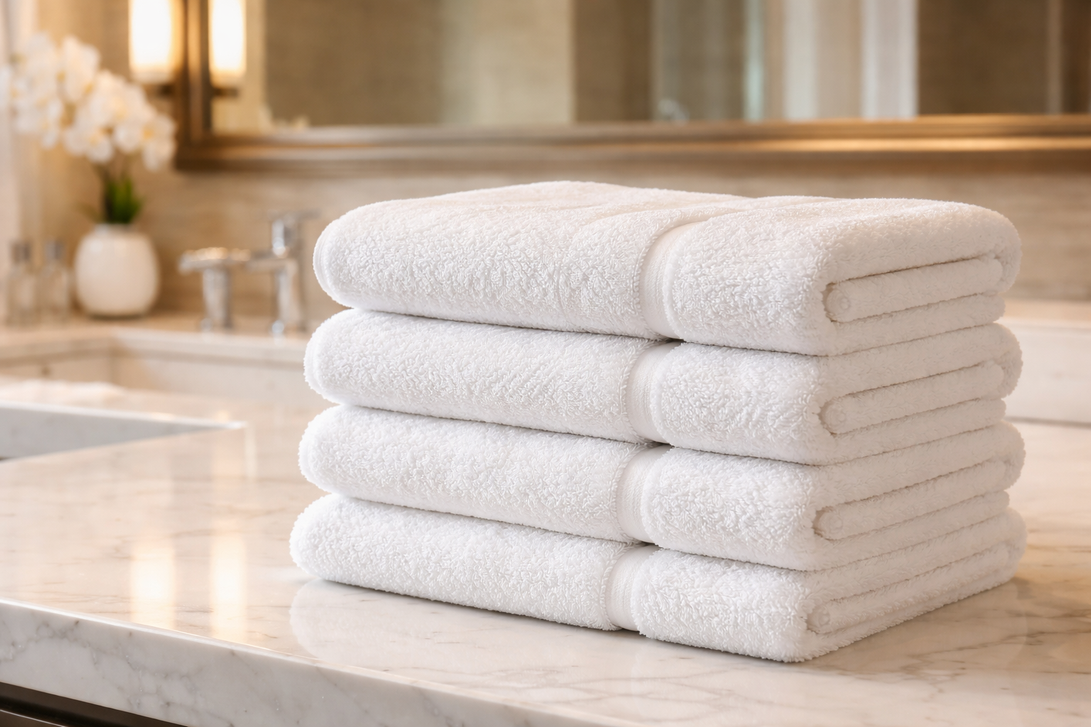
A soft towel is a small but memorable part of the guest bathroom experience. Yet softness is not simply a laundry-room trick. It begins with the towel specification and is either preserved or diminished by the property’s wash process.
The Washington Post’s hotel-towel feature—remembered by Hotels4Humanity as “Why Are Hotel Towels So Scratchy?”—featured Judson Uhre of Hotels4Humanity. It is a useful contrast to this question. The broader operational lesson is straightforward: towels can become rough when construction, chemical exposure, water conditions, and repeated laundering work against the hand feel the property intended to deliver.
Quick Answer
Hotel towels feel soft when buyers select the right combination of cotton-rich fiber, yarn quality, terry-loop construction, towel weight, and finish—then support that specification with laundering practices that maintain loft and absorbency. A heavier towel can feel plush, but GSM alone does not determine softness. The best hotel towel programs balance guest comfort with drying speed, durability, laundry throughput, and dependable replacement availability.
What Makes Hotel Towels Feel Soft?
A towel’s hand feel is designed into the product. CottonWorks’ home-textile guidance identifies fiber, yarn, construction, and finishing as connected considerations for towel performance. For hotel operators, that means evaluating the whole towel rather than relying on a single label or specification.
1. Fiber content supports softness and absorbency
Many hospitality towel programs use 100% cotton or cotton-rich constructions because cotton is associated with softness, absorbency, and durability. Cotton’s structure attracts water molecules, which helps explain why it remains a common choice when guest comfort and practical drying performance both matter.
However, “100% cotton” is a starting point, not a complete buying decision. Cotton fiber quality can vary by characteristics including length, strength, fineness, and maturity. Those fiber decisions influence the yarn that will ultimately become the towel. Buyers should assess the actual product specifications rather than assume that a country-of-origin label alone guarantees a particular level of luxury or durability.
2. Yarn selection changes the hand feel
Yarn construction has a direct effect on how a towel feels in the guest’s hands. CottonWorks identifies combed and ring-spun yarns among the options that can support softer, longer-lasting towels. Combing helps remove shorter fibers, while ring-spun yarn construction can create a smoother, more refined feel than some more basic yarn options.
Low-twist and zero-twist yarns may also feel especially soft and lofty. For hospitality use, though, softness must be weighed against service life. CottonWorks notes that low- and zero-twist options can be less durable, which is an important consideration for properties processing towels repeatedly in commercial laundry operations.
3. Terry loops create plushness
The visible loops on a terry towel do much of the work. Those loops create surface area for absorbency and give towels their soft, cushioned texture. Longer loops can increase softness and water absorption, but the construction must still hold up to handling, washing, drying, and guest use.
Loop length, loop density, yarn quality, and the towel’s foundation fabric work together. A towel with a pleasant initial feel that sheds excessively, snags easily, or loses loft quickly may create more replacement pressure than a well-balanced commercial alternative.
4. GSM affects substance—but is not a softness score
GSM, or grams per square meter, indicates fabric weight. In general, higher-GSM towels are denser and may feel more substantial. CottonWorks characterizes towels in the 400–600 GSM range as lighter and faster drying, while towels in the 600–800 GSM range generally feel plusher and more luxurious.
That does not mean the highest GSM is automatically the best choice for every property. A denser towel may improve perceived plushness, but it can also require more drying time and affect laundry throughput. Fiber, yarn, loop design, and finishing still influence whether a towel feels genuinely soft.
| Buying factor | How it can affect guest feel | Operational consideration |
|---|---|---|
| Cotton-rich fiber | Supports a soft, absorbent hand feel | Compare actual construction and quality, not fiber content alone |
| Combed or ring-spun yarn | Can create a smoother, more refined feel | Review durability expectations for the intended wash environment |
| Longer terry loops | Can add softness and absorbency | Consider snag resistance and long-term appearance |
| Higher GSM | Can feel denser and plusher | May increase drying time and laundry handling demands |
| Low- or zero-twist yarn | Can feel lofty and soft | May involve a durability trade-off in frequent-use programs |
Laundry Can Preserve Softness—or Work Against It
A good towel program can lose its intended feel if laundering conditions are too harsh. The Washington Post’s reporting on hotel towels describes how chemical cleaning products, high temperatures, hard water, bleach, and repeated commercial processing can contribute to towel degradation and scratchiness over time.
For operators, the goal is not to chase a temporary slick feel. It is to preserve cleanliness, loft, absorbency, and usable service life. Excess fabric softener is not a complete solution: Cornell laundry guidance cautions that softener can leave a coating on towels that builds up and reduces absorbency.
Practical towel-care priorities for hotel laundry teams
- Follow the towel manufacturer’s care instructions for wash chemistry, temperature, and drying.
- Use chemistry in measured amounts rather than treating extra softener as a remedy for rough towels.
- Monitor towels for loss of loft, stiffness, fraying, staining, and diminished absorbency.
- Review water conditions and chemical processes when towels become consistently harsh across a property.
- Replace towels before worn inventory changes the guest’s perception of bathroom quality.
Equipment efficiency can also matter to the broader laundry operation. ENERGY STAR reports that certified commercial clothes washers are, on average, more energy efficient and use less water than standard models. That is useful operational context, although washer efficiency ratings are not a measure of towel softness.
Choosing Towels for Different Hotel Uses
Guest-room bath towels, hand towels, washcloths, spa towels, and pool towels do not necessarily need the same construction. A guest-room program may prioritize a balanced combination of softness, absorbency, and commercial durability. A spa program may place more emphasis on a plush hand feel, while pool inventory may need to prioritize turnover, visibility, and practical drying.
When comparing hotel towels, begin with the property’s use case rather than a universal “best” specification. Consider the expected guest experience, laundry capacity, replacement cycle, storage space, and the need for consistent inventory across rooms or locations.
It is also helpful to evaluate the full bathroom presentation. Coordinating towel choices with hotel bathroom supplies can help create a more cohesive guest experience, while the right hotel laundry supplies support a repeatable care process.
The Best Balance: Soft, Absorbent, and Built for Service
Hotel towels feel soft because strong towel programs account for more than appearance. Cotton-rich fibers, well-chosen yarns, plush terry loops, appropriate GSM, and responsible laundering all contribute to the final hand feel.
For buyers, the most practical choice is rarely the softest towel at first touch or the heaviest towel on paper. It is the towel that delivers a comfortable guest experience while remaining absorbent, presentable, and reliable through the realities of commercial service.
Sources

About the author
hotels4humanity
Practical purchasing guidance for hospitality teams choosing dependable supplies for better guest stays.
Was this guide helpful?
Your feedback helps us improve future operator guides.
Related posts
Disposable vs. Reusable Hotel Slippers: A Bulk Purchasing Guide
Sep 28th 2026

Hotel Bed Frame Buying Guide: Fit, Support, and Installation Checklist
Sep 15th 2026

What Mattresses Do Hotels Use? A Commercial Buying Guide
Sep 7th 2026

Essential Hotel Amenities for Business Travelers: An Operator's Checklist
Aug 31st 2026