Hotel Laundry
How Hotels Keep White Towels White: A Commercial Laundry Troubleshooting Guide
What you'll learn
Quick Answer
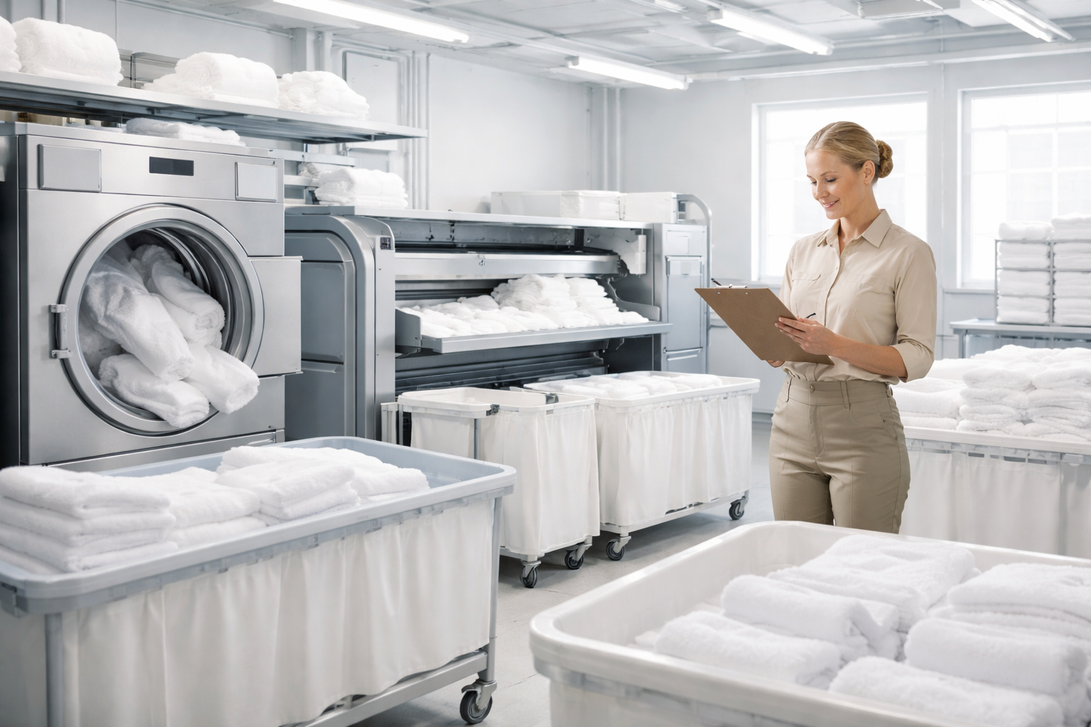
Hotels keep white towels looking bright through a controlled commercial-laundry process—not a single whitening product or universal wash formula. The most reliable approach is to sort towels by soil and processing need, use the approved program for the towel and equipment, verify chemical dispensing and rinse performance, monitor water and machine changes, and remove persistently stained or worn goods from the standard flow for review.
If white towels begin to look gray, yellowed, rough, or uneven, avoid an ad hoc chemistry change. Start with the towel manufacturer’s care documentation, the property’s approved laundry program, and a structured review with the qualified laundry-chemistry provider or equipment technician.
This guide complements Hotels4Humanity’s towel-care and guest-experience coverage. That article addresses the broader role towels play in guest perception; this one focuses on diagnosing recurring brightness and appearance problems in a commercial operation.
First, Define What “Not White” Means
Different symptoms should trigger different questions. Treat appearance issues as categories for investigation, not as automatic proof of one chemical, water, or equipment problem.
| What the team sees | Useful first questions |
|---|---|
| Gray or generally dull towels | Is the issue property-wide? Did it begin after a change to water, equipment, chemistry, a program, or a towel shipment? |
| Yellowing or discoloration | Is it isolated to a towel type, machine, shift, or storage area? Are affected towels following the documented process? |
| Visible, isolated stains | Were these goods identified and segregated for the property’s approved stain-review process rather than returned repeatedly to the standard load? |
| Rough or residue-like feel | Are results consistent across machines? Has rinse performance, approved product selection, or dispensing been verified? |
| Uneven results within the same inventory | Does the pattern follow a particular machine, program, operator shift, towel SKU, or delivery lot? |
Brightness is a visual-quality measure, not proof of hygienic cleanliness. Maintain your property’s separate sanitation, infection-control, and linen-handling procedures as applicable.
Use a “Verify Before Changing” Troubleshooting Path
1. Determine the scope of the problem
Start with a short incident log. Record when the issue first appeared, which towel type or supplier lot is affected, where it was processed, and whether there was a recent change in equipment, water treatment, chemical program, staffing, or wash configuration.
- One towel or a few towels: Route the goods through the property’s approved stain-review or removal process.
- One load, machine, program, or shift: Review operator steps and machine-specific performance before changing the overall process.
- Most white towels across the property: Treat it as a system review involving loading, programs, dispensing, rinsing, water conditions, and maintenance.
2. Confirm sorting and load classification
The EPA recommends separating laundry according to the number of wash cycles required, so more heavily soiled articles receive the process they need without extending processing for goods that do not require it. For hotels, that means following a documented sort plan based on towel type, soil level, and the approved workflow.
Confirm that towels were not mixed with goods that require a different process and that the selected program matched the load. The EPA also recommends using appropriate cycles and managing full loads for efficient operation; this is a process-control and water-management consideration, not a promise that a fuller load will make towels brighter.
3. Verify that the intended program actually ran
Before changing products or calling for a formula adjustment, check the basics:
- Was the correct approved program selected?
- Was the load prepared according to the property’s operating procedure?
- Did the machine complete the expected cycle without alarms, interruptions, or manual overrides?
- Do comparable loads produce different results on another machine or program?
A controlled comparison is useful: keep the towel type and normal operating procedure consistent, then compare output by machine, program, or shift. Document the result for the supplier or technician rather than asking staff to improvise settings.
Review Water, Chemistry, Rinsing, and Equipment as One System
When white towels lose brightness across multiple loads, the towel may be showing the result of a process issue upstream. EPA commercial-laundry guidance notes that detergent selection and use should fit the equipment, and that unsuitable detergent can create excess suds and leave goods incompletely washed or rinsed. That makes dispensing and rinse performance worth verifying with the qualified provider—not manually changing chemical quantities on the floor.
Operational checks to document
- Approved chemistry: Confirm the products in use are the ones approved for the towel construction, equipment, and property program.
- Dispensing: Ask the qualified laundry-chemistry provider to verify delivery, product connection, and formula settings.
- Rinse performance: Review whether output concerns appear as a consistent residue-like feel, uneven appearance, or machine-specific pattern.
- Water conditions: Note changes in municipal supply, water treatment, softening, filtration, reuse systems, or utility interruptions.
- Machine condition: Review service history, recurring alarms, leaks, mechanical concerns, and differences between washers.
- Water-use patterns: EPA recommends monitoring submeters where available to establish normal use patterns and help identify leaks or maintenance issues.
EPA also advises commercial facilities to consult laundry-chemical suppliers on laundry methods and work with equipment suppliers on service and maintenance. That coordination is especially important when a visual-quality issue is widespread or begins suddenly.
Be Careful After Process or Efficiency Changes
If towels began looking different after a washer replacement, water-reuse project, ozone installation, altered rinse configuration, chemical supplier change, or water-treatment adjustment, review the complete system with the relevant vendors. EPA identifies water reuse and ozone as potential water-efficiency options, while noting that recycling systems can require chemical and detergent adjustments.
Water-efficiency projects should not be treated as automatic whitening solutions. Their performance should be evaluated against the property’s documented textile-care, guest-quality, equipment, and operating requirements.
Stain Handling: Segregate, Review, Then Decide
Persistent visible stains should not automatically trigger repeated processing in the standard towel stream. A better operational approach is to segregate affected goods, record the pattern, and follow the property’s approved stain-review procedure.
For repeat issues, ask:
- Are the same stain types recurring from a particular guest area, department, or use case?
- Are affected towels concentrated in a certain inventory lot or towel construction?
- Are towels being reprocessed beyond the property’s normal quality-control practice?
- Has the textile reached a condition where replacement is more appropriate than additional processing?
Follow the towel manufacturer’s care instructions and your approved commercial program. Do not assume every white towel permits the same bleaching or chemical treatment. Textile care guidance is product-specific, and bleach warnings depend on what the manufacturer has determined will not harm the product under the stated care process.
When Replacement Is the Better Operating Decision
Not every towel can or should be restored to first-quality appearance. Build a clear removal standard for goods that remain visibly stained, have permanent discoloration, feel consistently compromised after process verification, or no longer meet the property’s guestroom presentation standard.
Replacement decisions are easier when the laundry team can distinguish a process problem from normal textile wear. Keep records by towel SKU, lot, department, and removal reason. Those records can help identify whether the next step is a vendor discussion, a process correction, or a replenishment order.
When replenishing, compare construction, intended use, and pack requirements with your operating needs. See the Hotel Towel Buying Guide for purchasing considerations, or browse Hotel Towels for hotel-focused options. For guest-facing softness and towel feel, read Why Are Hotel Towels So Soft?.
Chemical Safety Is Part of Troubleshooting
Commercial laundry troubleshooting must stay within the property’s chemical-safety program. OSHA identifies hazards associated with laundry and housekeeping chemicals, including unlabeled containers, splashing during transfers, and exposure to detergents, disinfectants, and concentrated soaps.
- Use only approved, labeled products and the designated dispensing system.
- Keep Safety Data Sheets accessible and maintain required training, labeling, inventory, and emergency procedures.
- Use required controls and personal protective equipment for the task and product.
- Do not mix products, create on-floor “boost” formulas, or manually alter chemical doses without direction from the qualified provider.
For property-specific settings, product compatibility, and formula changes, work with the towel manufacturer and qualified laundry-chemistry provider.
A Simple Escalation Guide
| If you find... | Contact... | Bring this documentation |
|---|---|---|
| Inconsistent results from one washer or program | Equipment service partner and laundry manager | Machine, program, shift, dates, alarms, and comparison-load results |
| Property-wide dullness, residue-like feel, or rinse concerns | Qualified laundry-chemistry provider | Towel type, affected areas, process records, recent product or formula changes, and machine comparisons |
| Change following water treatment, reuse, or supply conditions | Water-treatment partner, chemistry provider, and equipment partner | Timeline of the change, water-system notes, affected equipment, and output samples |
| Early wear, recurring discoloration, or lot-specific concerns | Towel vendor or manufacturer | SKU, lot information, purchase history, care documentation, and removal records |
Sources
- U.S. Environmental Protection Agency: WaterSense at Work—Laundry Equipment
- U.S. Environmental Protection Agency: WaterSense at Work Best Management Practices
- Occupational Safety and Health Administration: Laundry—Hazardous Chemicals
- Federal Trade Commission: Care Labeling Rule
- Hotels4Humanity: Hotel Towels—The First Frontier of Hotel Luxury

About the author
hotels4humanity
Practical purchasing guidance for hospitality teams choosing dependable supplies for better guest stays.
Was this guide helpful?
Your feedback helps us improve future operator guides.
Related posts
Disposable vs. Reusable Hotel Slippers: A Bulk Purchasing Guide
Sep 28th 2026
Hotel Bed Frame Buying Guide: Fit, Support, and Installation Checklist
Sep 15th 2026

What Mattresses Do Hotels Use? A Commercial Buying Guide
Sep 7th 2026

Essential Hotel Amenities for Business Travelers: An Operator's Checklist
Aug 31st 2026