Hotel Amenities
How to Stock Hotel Bathroom Amenities Without Overstocking
What you'll learn
Quick Answer
Stock hotel bathroom amenities with a par-level system tied to rooms in service, typical occupancy, the amenity standard for each room type, supplier lead times, reorder cadence, and safe storage capacity. Replenish during the normal clean-and-reset workflow so teams restock consistently without building unnecessary “just in case” inventory.
1. Define your property standard
Overstocking often starts with inconsistent standards: different teams restock different amounts, and purchasing compensates by ordering extra. Before calculating pars, document what belongs in every bathroom at turnover.
Define the set by guest type and room type
- Base set: Items that must be present in every room at check-in.
- Upgrade set: Additional items reserved for premium floors, suites, or other defined room types.
- Request-only items: Slow-moving supplies stored centrally, issued on request, and counted separately.
Organizing supplies by function helps keep the standard clear and prevents ad hoc purchasing. Hotels4Humanity groups common programs under Hotel Soap and Amenities and Hotel Bathroom Supplies.
2. Build a working par system
A par is the quantity needed to operate smoothly between deliveries. For bathroom amenities, begin with expected room turns and the replacement standard for each room type, then refine the levels as actual consumption becomes clear.
A five-step par-level process
- Confirm the number of rooms currently in service.
- Estimate normal and busy-week room turns from the occupancy forecast.
- Apply the documented amenity standard for each room type.
- Add enough coverage for supplier lead time, order frequency, and a reasonable safety buffer.
- Set a maximum that fits secure storage and can still be counted quickly.
Par-level worksheet
| Input | What it controls | Where to verify it |
|---|---|---|
| Rooms in service | The rooms available to sell and turn | Operations or room inventory status |
| Typical occupancy range | Expected normal-week and busy-week volume | Forecast and pacing reports |
| Amenity standard per room turn | The base or upgrade set placed at turnover | Brand standards and housekeeping SOP |
| Lead time and order frequency | How much inventory must cover the replenishment window | Supplier terms and purchasing schedule |
| Storage capacity | The maximum that can be stored securely and counted reliably | Back-of-house storage plan |
Label three inventory levels
- Minimum: Safety stock for late deliveries or unexpected demand.
- Reorder point: The on-hand level that triggers the next purchase order.
- Maximum: The highest useful quantity that fits the available storage without tying up unnecessary cash.
Even without a complex formula, labeled minimum and maximum levels make ordering more consistent.
3. Standardize the clean-and-reset workflow
Overstocking is not only a purchasing issue. When restocking happens inconsistently, managers compensate by hoarding or over-ordering.
Operational controls that reduce waste
- Use one touchpoint: Restock amenities during the same step of every room clean so items are less likely to be missed or placed twice.
- Define replacement rules: Document what is replaced at turnover, during a stayover, or only when empty.
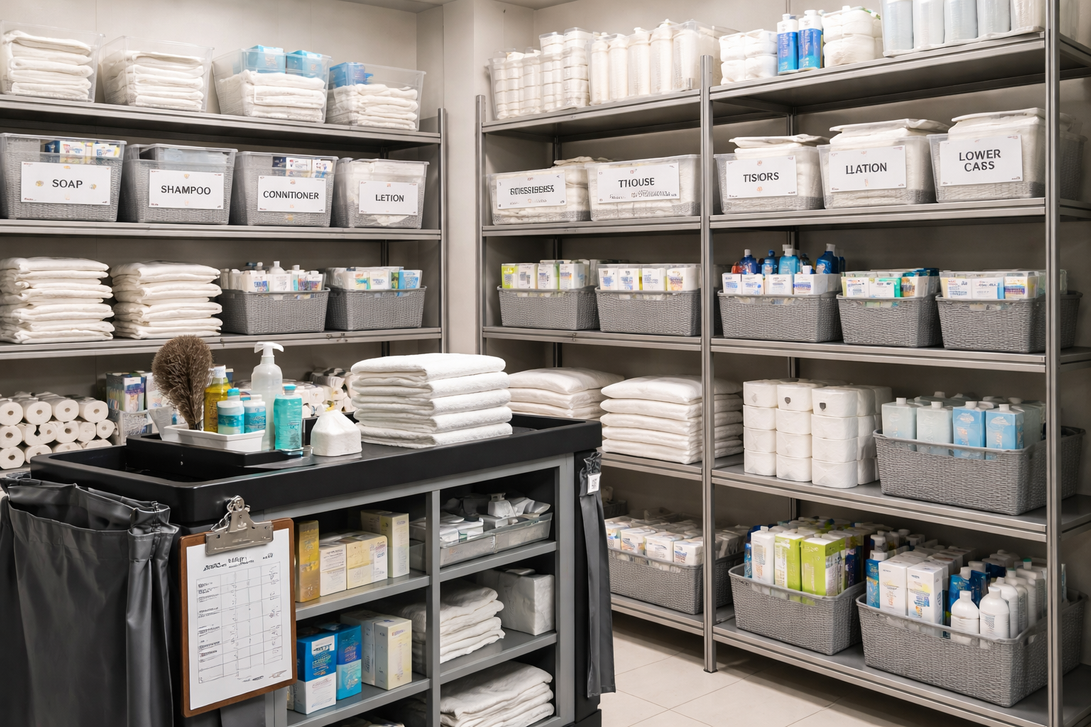
- Limit mini-stashes: Keep primary stock in a controlled location and place only shift-level quantities on carts.
CDC guidance for community facilities recommends regular cleaning of high-touch surfaces and cleaning other surfaces when visibly dirty, with disinfection used where people have obviously been ill. A predictable cleaning rhythm also gives teams a consistent point for room-supply replenishment.
Review the CDC’s facility cleaning and disinfection guidance.
4. Match orders to storage reality
Bulk pricing can be attractive, but it can also create months of inventory that is difficult to count accurately. Small amenity items are especially easy to overbuy and hard to track when storage overflows.
Choose a disciplined ordering cadence
- Weekly: Useful for properties with limited storage or variable occupancy.
- Biweekly: Practical when lead times are stable and counts are reliable.
- Monthly: Best reserved for operations with strong controls and sufficient secure storage.
When purchasing is consolidated across departments, coordinate amenities with other Hotel Room Supplies without forcing every category into an oversized monthly purchase.
5. Reduce hidden overstock
Multiple versions of the same item—different scents, sizes, or brand lines—can make one preferred SKU appear low even when total inventory is high.
- Core line: Select one primary program used property-wide.
- Exception list: Document alternates for specific room types or operating needs.
- Phase-out plan: Stop reordering discontinued SKUs on a set date and use the remaining stock intentionally.
Align backstock labels and par levels to the exact SKUs in the property’s approved amenity program.
Make inventory counts quick
- Bin counts: Store supplies in labeled bins with a known quantity per bin.
- Two-bin system: Reorder when the first bin is empty and use the second as the buffer.
- Cycle counts: Count a few high-volume items every week instead of relying on an occasional full count.
Printable buyer checklist
Before placing the next purchase order, confirm:
- Every room type has a written turnover standard.
- Current on-hand quantities are known for the highest-volume amenities.
- The order is based on lead time and a defined reorder point.
- The delivery will fit in secure storage without overflow.
- Old or alternate SKUs are not creating a phantom shortage.
- The maximum level still allows the team to count inventory quickly.
Related hotel supplies

Bottom Line
Avoiding overstock does not require perfect forecasting. It requires a clear amenity standard, workable minimum and maximum levels, a consistent clean-and-restock rhythm, quick counts, and an order cadence that respects real storage capacity. Standardize the program first, then base each purchase order on what the property will actually use.

About the author
hotels4humanity
Practical purchasing guidance for hospitality teams choosing dependable supplies for better guest stays.
Was this guide helpful?
Your feedback helps us improve future operator guides.
Related posts

Hotel Crib Buying and Inspection Checklist for Operators
Oct 19th 2026
Disposable vs. Reusable Hotel Slippers: A Bulk Purchasing Guide
Sep 28th 2026
Hotel Bed Frame Buying Guide: Fit, Support, and Installation Checklist
Sep 15th 2026

What Mattresses Do Hotels Use? A Commercial Buying Guide
Sep 7th 2026