Hospitality Purchasing
Restaurant Tablecloth Buying Guide: Sizes, Fabrics, and Daily Care
What you'll learn
Quick Answer
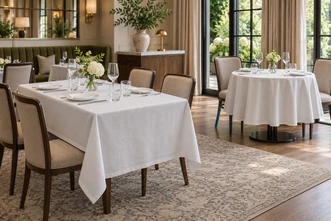
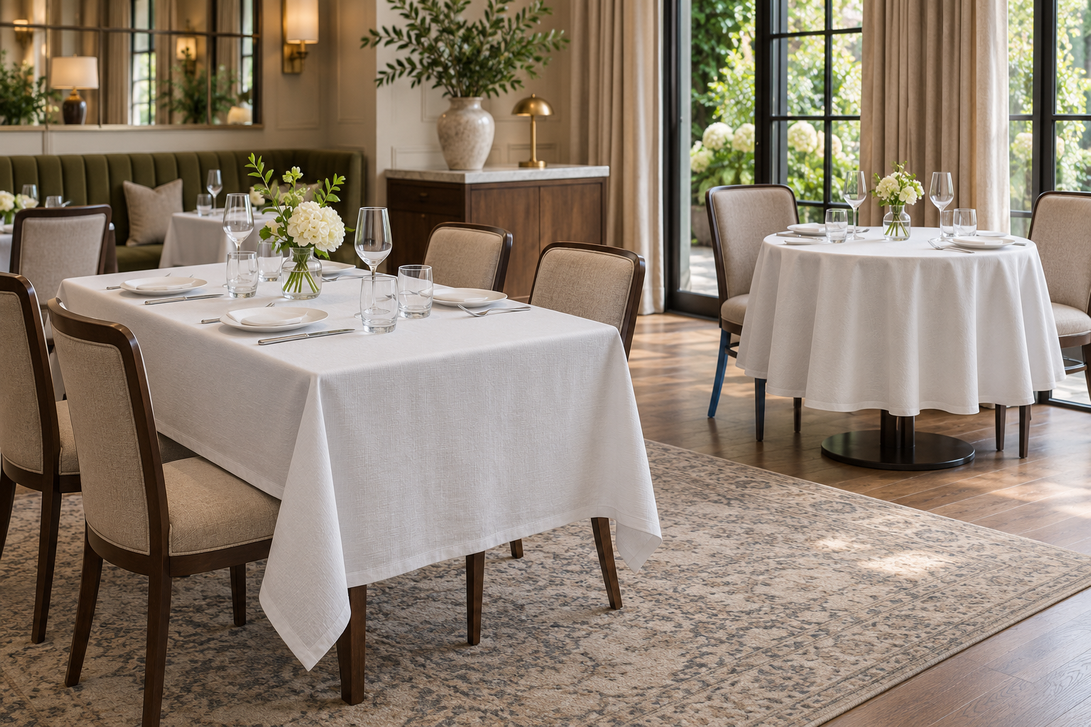
Choose reusable restaurant tablecloths by measuring each table and deciding how far the cloth should hang over the edge. Calculate a target size, check a laundered sample on the table, and compare fabrics with your laundry provider. Then plan quantities around service changes, laundry turnaround and a reserve. Confirm the exact size, material and pack before ordering. Browse the restaurant tablecloth range once you have your measurements.
How to Calculate Tablecloth Size
The drop is the amount of fabric that hangs down from the tabletop edge. Choose a drop that suits your dining room or event space, then measure the table in inches. Consider the table height, chairs and floor clearance: there is no single drop length that works for every setting.
Rectangular and square tables
Measure the tabletop's length and width. Add twice the desired drop to each measurement:
- Cloth length = table length + (2 × desired drop)
- Cloth width = table width + (2 × desired drop)
For a square table, use the same calculation for each side. Corners of a square or rectangular cloth can hang lower than the fabric at the midpoint of each edge. Check the actual drape and clearance around chairs and above the floor.
Round tables
Measure the tabletop's diameter across its widest point. For a round cloth, use:
Cloth diameter = table diameter + (2 × desired drop)
This sizing approach is also described in WebstaurantStore's table linen guide. Measure a sample on the actual table after it has been processed by your laundry, since the finished fit is what matters during service.
| Table shape and size | Desired drop | Calculated cloth size |
|---|---|---|
| Rectangle: 30 × 48 inches | 10 inches | 50 × 68 inches |
| Square: 36 × 36 inches | 10 inches | 56 × 56 inches |
| Round: 60-inch diameter | 15 inches | 90 inches round |
These are planning calculations, not confirmed stocked variants. If an exact size is unavailable, compare nearby options on the table and check the resulting drop on every side before committing to a larger order. Keep a simple list matching each table type to its chosen cloth size so staff can set rooms consistently.
For tables with straight edges, review the Oxford rectangular and square table linens. If your dining room uses circular tables, compare the Oxford round table linens and check the drop for the selected size.
Compare Fabrics for Daily Service
Fabric choice affects the look and feel of a table and the work needed to prepare cloths for service. Cotton, cotton/polyester blends and spun polyester are general fabric choices. This comparison does not mean every fabric is currently available as a Hotels4Humanity tablecloth. The fiber name alone does not tell you how every cloth will perform: weave, finish and laundry processing matter too.
Cotton
Cotton is worth considering when its hand and appearance suit the room. Cotton can absorb moisture and cotton fabric can wrinkle, while finishes can change wrinkle resistance. Ask to handle a sample and check what finishing it needs to meet your presentation standards.
Cotton/polyester blends
Blends combine fibers, but proportions and construction differ among products. Compare the actual sample with your preferred cotton and polyester options for feel, appearance and the amount of finishing your team or laundry expects to perform. Check the product label for the specific fiber content.
Spun polyester
Spun polyester is another option for reusable commercial table linen. Ganesh Mills' table linen listings, for example, include spun-polyester cloths. Examine a sample's texture and drape in the dining room, then review it after processing for appearance and finishing needs. Do not assume every polyester cloth has the same stain or wrinkle performance.
For any fabric, ask your laundry provider to process a sample according to its care instructions before you standardize on it. Inspect the result in your normal lighting and test it on the table with your chairs and place settings.
Plan the Number of Cloths
Start with the number of tables using the same cloth and the number of clean cloths each table needs per day. Account for cloths in service and away at the laundry, then add a reserve for unexpected changes or delays.
Example: A restaurant has 20 tables that all use the same cloth and uses two cloths per table per day. Assume a two-day cycle includes the cloths in service and the used cloths return before the next cycle begins. The calculation is 20 × 2 × 2 = 80 cloths. Adding an illustrative reserve of 10 gives a planning quantity of 90 cloths.
This is an example, not an industry rule. If clean replacements are needed before the laundry returns, allow for that overlap as well. Adjust the calculation for your actual change frequency, pickup and return schedule, and busy events. Calculate separately for sizes, shapes and colors that cannot be used interchangeably. For daily counts, storage and replacement planning, see our guide to controlling hotel linen inventory.
Set Up a Practical Care Routine
Share the selected cloth's care label with your laundry provider before placing a full order. Confirm the appropriate wash chemistry, temperatures, drying and finishing for that product and the provider's equipment. Instructions for one manufacturer's fabric should not be assumed to apply to another. Hotels that process their own linens can also review our guide to planning an on-premises laundry when considering equipment and workflow.
- Give staff a clear place to collect used tablecloths and keep them separate from clean stock.
- Tell the laundry provider about recurring food or beverage stains and ask how to handle them under the cloth's care instructions.
- Inspect returned cloths for spots, damage and presentation before putting them back into service.
- Store clean, fully dry cloths in a clean, dry area, arranged so staff can find the right size and shape.
- Track shortages or repeated changes in appearance so you can discuss them with the laundry provider and supplier.
Tablecloth Buying Checklist
- List table shapes, tabletop measurements and heights for each dining and event space.
- Choose the desired drop and calculate a target cloth size for each table.
- Check chair, corner and floor clearance with a processed sample.
- Compare fabric samples for hand, drape, appearance and finishing needs.
- Confirm care instructions and laundry turnaround with the provider.
- Calculate quantities by size, service changes, turnaround and reserve.
- Confirm the exact selected variant, material, pack and current purchasing details before ordering.
Complete your table setting with restaurant napkins, and confirm the material, pack and purchasing details of each option you select.
Restaurant Tablecloth FAQs
What size tablecloth fits a 60-inch round table?
A 90-inch round cloth gives a calculated 15-inch drop on a 60-inch round table: (90 − 60) ÷ 2 = 15. This is a sizing example, not confirmation of a stocked variant. Check the finished fit with a laundered sample.
How far should a restaurant tablecloth hang down?
Choose the drop to suit the table height, chairs and service style. Check clearance above the floor and around the corners before ordering. There is no single drop length for every dining room.
Should I choose cotton or polyester tablecloths?
Compare samples for the feel, drape and appearance your dining room needs, then ask your laundry provider to process them under their care instructions. Fiber content, weave, finish and processing all matter; a fiber name alone does not establish stain or wrinkle performance.
Sources

About the author
hotels4humanity
Practical purchasing guidance for hospitality teams choosing dependable supplies for better guest stays.
Was this guide helpful?
Your feedback helps us improve future operator guides.