cotton polyester hotel sheets
Organic vs Regular Hotel Bedding: Is It Worth It?
What you'll learn
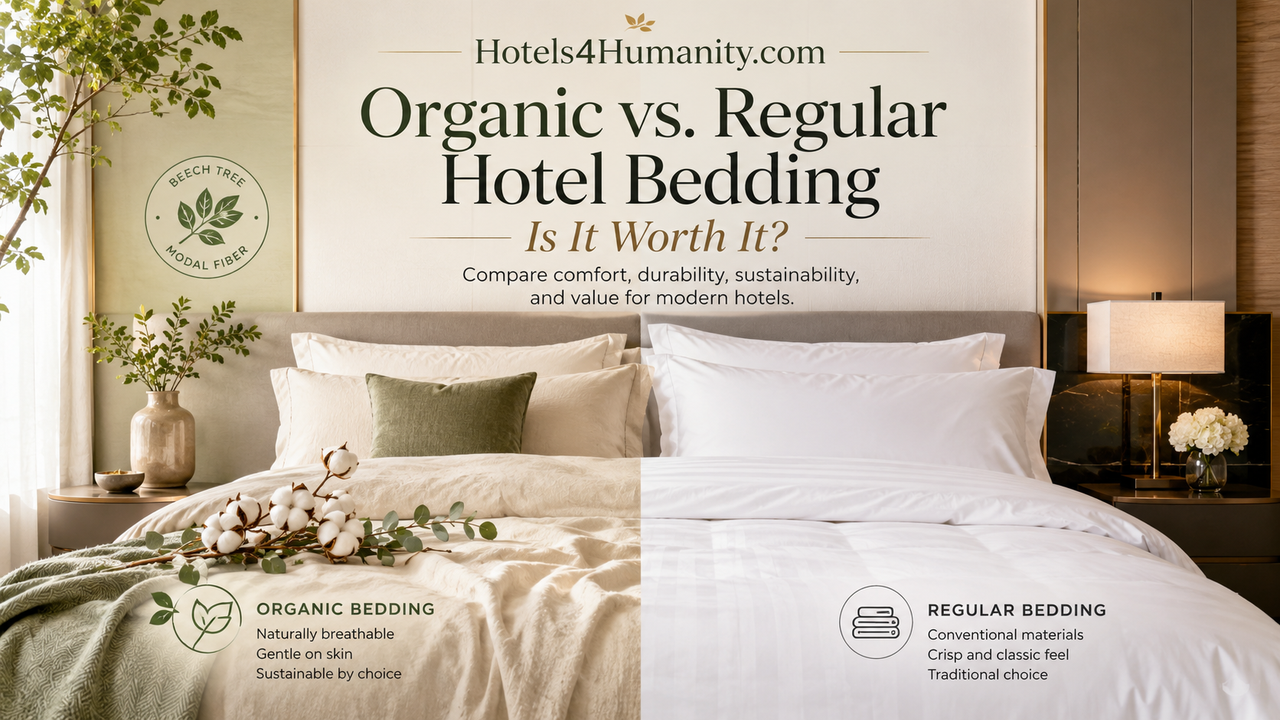
Organic hotel bedding can be worth it, but it is not automatically the best choice for every property. For most hotels, the right answer depends on the room rate, guest promise, laundry process, replacement cycle, and whether the property can turn certified organic bedding into a real brand advantage.
If your hotel is luxury, boutique, wellness-focused, eco-positioned, or trying to justify a more premium room experience, organic cotton bedding may support the story guests are already buying. If your property is focused on high turnover, tight operating costs, and easy laundry performance, conventional cotton, cotton-rich blends, or microfiber products may still be the better operating choice.
This guide compares organic and regular hotel bedding from the perspective that matters most to hotel owners: comfort, credibility, cost, durability, laundering, sustainability, and guest perception.
Quick Answer: Is Organic Hotel Bedding Worth It?
Organic hotel bedding is worth it when the hotel can use certified organic materials to support a larger value proposition: a wellness room, boutique positioning, sustainability standards, luxury bedding program, or a guest experience where natural materials matter.
Organic bedding is less likely to be worth the premium when the hotel is buying only on lowest total cost, fast laundering, wrinkle control, and replacement efficiency. In those settings, well-specified regular bedding such as T-180 cotton/poly hotel sheets, conventional cotton, cotton-rich blends, or microfiber bed sheets may make more sense.
The practical rule is simple: buy organic when the claim is certified, visible, and meaningful to the guest. Buy regular bedding when operational performance is the main priority.
What Counts as Organic Hotel Bedding?
In hotel procurement, "organic bedding" usually means bedding made with certified organic cotton. The strongest organic claim is not just a product page saying "natural" or "eco." It should be backed by a recognized textile standard, clear fiber content, and documentation from the supplier.
GOTS is one of the most important standards for organic textile claims. GOTS label grades distinguish between products with high certified organic fiber content and products made with a lower organic-fiber share. For hotel buyers, that matters because "organic cotton" can mean very different things depending on the finished product, not just the raw fiber.
OEKO-TEX STANDARD 100 is different. It is not the same as organic certification. It tests textile components for harmful substances, which makes it useful for skin-contact products such as sheets, pillowcases, mattress pads, blankets, and towels. A hotel can use OEKO-TEX as a safety and chemical-residue signal even when the product is not organic.
That distinction is important. Organic certification answers one question. Harmful-substance testing answers another. Recycled-content standards and fair-labor standards answer still other questions. A strong hotel bedding program may need more than one type of certification.
What Counts as Regular Hotel Bedding?
Regular hotel bedding is not one material. It can include conventional cotton, cotton/polyester blends, microfiber, polyester, lyocell, modal, bamboo viscose, and mixed-fiber products. Each one solves a different operating problem.
Conventional cotton remains familiar, breathable, and guest-friendly. Cotton/polyester blends are common in hospitality because they balance comfort with strength, wrinkle resistance, and drying efficiency. Hotel sheets and linen in 50/50, 55/45, or 60/40 blends are often chosen because they work well in repeated hotel laundering.
Microfiber and polyester-rich bedding usually win on low first cost, quick drying, and easy presentation. They may not deliver the same natural-fiber story as cotton, but they can be practical for properties that need easy-care bedding at scale.
Lyocell and modal belong in the regenerated-cellulosic family. They are often marketed around softness, cooling, and moisture management, but hotels should evaluate them by fiber content, process claims, durability, wash performance, and certification rather than by marketing language alone.
Organic vs Regular Hotel Bedding Comparison
| Option | Best fit | Main advantage | Main tradeoff |
|---|---|---|---|
| Certified organic cotton | Luxury, boutique, wellness, and sustainability-led hotels | Strongest natural and certified organic story | Higher first cost and no automatic laundry savings |
| Conventional cotton | Hotels that want natural comfort without the organic premium | Breathability, familiar hand feel, broad availability | Can wrinkle, shrink, and dry more slowly than blends |
| Cotton/polyester blends | High-turnover hotel operations | Strong balance of comfort, durability, drying, and cost | Less pure natural-fiber positioning than cotton |
| Microfiber or polyester | Budget-conscious and easy-care bedding programs | Low first cost, quick drying, wrinkle resistance | Weaker sustainability story and synthetic-fiber concerns |
| Lyocell, modal, or bamboo viscose | Properties testing softer or cooling-positioned bedding | Comfort and moisture-management appeal | Claims depend heavily on process, blend, and certification |
The Laundry Reality Matters More Than the Label
Hotel bedding does not live in a showroom. It lives in carts, washers, dryers, storage rooms, guest rooms, stain treatment, and housekeeping schedules. A sheet that feels wonderful on day one still has to survive repeated washing, drying, folding, storage, and room turnover.
That is why many hotels continue to use cotton/polyester blends. The blend can help with strength retention, wrinkle control, drying time, and consistent room presentation. For properties that turn rooms every day, those operational details affect both labor and cost.
Organic cotton can still perform well, but it should be tested in the actual laundry environment before a full rollout. A hotel should track shrinkage, drying time, wrinkling, rewash rate, stain loss, guest comments, and replacement interval. Without that data, "organic" is a brand claim, not an operating plan.
Guest Comfort: What Guests Actually Notice
Guests rarely know the full fiber story unless the hotel tells them. They do notice whether the bed feels clean, smooth, breathable, soft, and consistent. They notice if the sheets feel rough, the pillow is flat, the blanket is worn, or the room feels under-supplied.
Organic cotton can support a premium sleep story, especially when paired with quality pillows, mattress protection, and top-of-bed layers. But comfort does not come from fiber origin alone. Weave, thread count, yarn quality, finish, laundering, pillow choice, and blanket weight all affect the guest experience.
If the goal is to improve comfort, start with the full bed system: sheets, pillowcases, pillows, hotel blankets, mattress pads, protectors, duvet covers, and housekeeping par levels. Organic bedding can be part of that system, but it should not be the only decision.
Sustainability: Organic Is Stronger, but Not Simple
The strongest sustainability case for organic cotton is upstream. Certified organic cotton reduces reliance on synthetic agricultural inputs and gives the hotel a more defensible sourcing story than vague "green" wording. Current cotton life-cycle research also shows why the answer is not binary: environmental results depend on yield, irrigation, farming system, manufacturing, energy mix, laundering, and product life.
Synthetic-rich bedding can be operationally efficient, but synthetic textiles are also part of the microfiber and microplastic conversation. Blends can be harder to recycle than mono-material textiles because separating fibers is difficult. That does not mean blends are wrong for hotels. It means the hotel should be honest about what problem the product is solving.
A sustainability claim is strongest when it is specific: certified organic cotton, OEKO-TEX tested, recycled polyester content, GRS-tracked recycled input, or Fairtrade textile sourcing. Vague wording such as "eco-friendly," "natural," or "green" is weaker and harder to defend.
When Organic Hotel Bedding Makes Sense
Organic bedding is most likely to make sense when one or more of these conditions is true:
- The hotel is positioned as luxury, boutique, wellness, spa, retreat, or sustainability-led.
- The hotel can explain the certification clearly to guests.
- The property can absorb the higher first cost through room rate, package value, or brand standards.
- The bedding claim is part of a larger room experience, not an isolated purchase.
- The hotel has a laundry process that protects the product's lifespan.
- The owner wants fewer vague sustainability claims and more documentation-backed procurement.
In those cases, organic cotton can help the hotel tell a stronger story about the room. It can support wellness messaging, natural-material preferences, sustainability pages, in-room cards, and direct-booking content.
When Regular Hotel Bedding Makes More Sense
Regular bedding may be the better choice when operational performance is more important than a premium sustainability claim. That is often true for economy hotels, high-turnover properties, extended-stay operations, roadside hotels, and properties with tight laundry constraints.
In those settings, a well-specified cotton/poly blend can be the practical winner. For example, Martex Green sheets and linen use a sustainable-cotton and recycled-polyester approach, while many standard hotel programs use 50/50, 55/45, or 60/40 blends to balance comfort and durability.
Hotels should not treat regular bedding as low quality by default. A dependable conventional cotton, microfiber, or cotton/poly program can still improve guest comfort when the product is consistent, properly stocked, and matched to the property.
Certification Checklist for Hotel Buyers
Before buying organic or regular bedding, ask suppliers for specific proof:
- What is the exact fiber content?
- Is the finished product certified, or only one input material?
- Does the product have a GOTS, OEKO-TEX, GRS, Fairtrade, or other certificate number?
- What laundering instructions does the manufacturer provide?
- Has the item been tested in commercial laundry conditions?
- What is the expected shrinkage range?
- How is the product sold: each, dozen, pack, or case?
- Can replacement items be reordered consistently?
The certificate name matters, but the certificate scope matters more. A logo on a website does not always mean the finished hotel sheet, pillowcase, or blanket carries the exact claim the buyer thinks it does.
How to Decide for Your Property
Use this simple decision path:
- Start with the guest promise. Is the room trying to feel premium, wellness-focused, practical, economical, or brand-standard?
- Check the laundry reality. Can your laundry process support the material without excessive shrinkage, wrinkling, drying time, or replacement cost?
- Price the full program. Compare sheets, pillowcases, duvet covers, protectors, blankets, and backup inventory, not just one item.
- Verify the claim. Ask for certification documents and product specs before marketing the bedding as organic, sustainable, recycled, or chemical-tested.
- Pilot before rollout. Test a room block or small order before replacing the whole property.
This approach keeps the decision grounded. It prevents a hotel from overpaying for a claim guests will never see, and it also prevents a hotel from ignoring a premium bedding story that could support stronger guest perception.
Where Hotels4Humanity Fits In
Hotels4Humanity helps hotels compare practical bedding options across comfort levels, materials, brands, pack sizes, and price points. Whether your property needs organic cotton, cotton-rich sheets, microfiber, sustainable-cotton blends, hotel pillows, blankets, mattress protection, or a full bedding refresh, the goal is the same: choose products that fit the guest experience and the operation.
For many hotels, the best bedding program is not the most expensive one. It is the one that keeps rooms comfortable, housekeeping supplied, laundry manageable, and purchasing consistent over time.
Need help comparing organic and regular hotel bedding? Start with your property type, laundry setup, and guest promise, then choose the bedding program that supports all three.
Final Takeaway
Organic hotel bedding is worth it when the certification, comfort, and brand story can support a better guest experience or a stronger room-rate position. Regular bedding is often the smarter choice when the hotel needs durability, drying efficiency, wrinkle control, and lower replacement cost.
The best hotel bedding decision is not organic versus regular in the abstract. It is the material, certification, construction, and care plan that your hotel can sustain every day.
FAQ
Is organic hotel bedding better than regular bedding?
Organic hotel bedding can be better for hotels that need a certified natural-material story, but it is not automatically better for every operation. Regular cotton, cotton/poly blends, and microfiber can be better for high-turnover hotels focused on laundry efficiency and total cost.
What certification should hotels look for in organic bedding?
GOTS is one of the most important standards for organic textile claims. Hotels may also look for OEKO-TEX STANDARD 100 for harmful-substance testing, GRS for recycled content, and Fairtrade where labor sourcing is part of the claim.
Are cotton/polyester blend sheets good for hotels?
Yes. Cotton/polyester blends are common in hospitality because they balance comfort, strength, wrinkle resistance, drying efficiency, and cost. They are often a practical choice for high-turnover properties.
Is bamboo bedding always more sustainable?
No. Bamboo bedding is often bamboo viscose, which is a regenerated-cellulosic fiber. Its sustainability depends on the processing method, chemical controls, product construction, and certifications, not just the bamboo source.
Should a hotel switch every room to organic bedding?
Not always. Some hotels may get better results by using organic bedding in premium rooms, wellness rooms, or suites first, then expanding only if guest feedback, laundry performance, and replacement cost support the change.
Sources and Further Reading
- GOTS: Organic Fibres
- OEKO-TEX STANDARD 100
- Textile Exchange Standards
- USDA: Organic Textiles
- Fairtrade Textile Standard
- European Environment Agency: Microplastics from Textiles
- Environmental Sustainability of Cotton: A Systematic Literature Review of Life Cycle Assessments
- Industrial Washing Conditions and Mechanical Strength of Bed Linens

About the author
Hotels For Humanity
Practical purchasing guidance for hospitality teams choosing dependable supplies for better guest stays.
Was this guide helpful?
Your feedback helps us improve future operator guides.
Related posts

Hotel Crib Buying and Inspection Checklist for Operators
Oct 19th 2026
Disposable vs. Reusable Hotel Slippers: A Bulk Purchasing Guide
Sep 28th 2026

Hotel Bed Frame Buying Guide: Fit, Support, and Installation Checklist
Sep 15th 2026
What Mattresses Do Hotels Use? A Commercial Buying Guide
Sep 7th 2026