
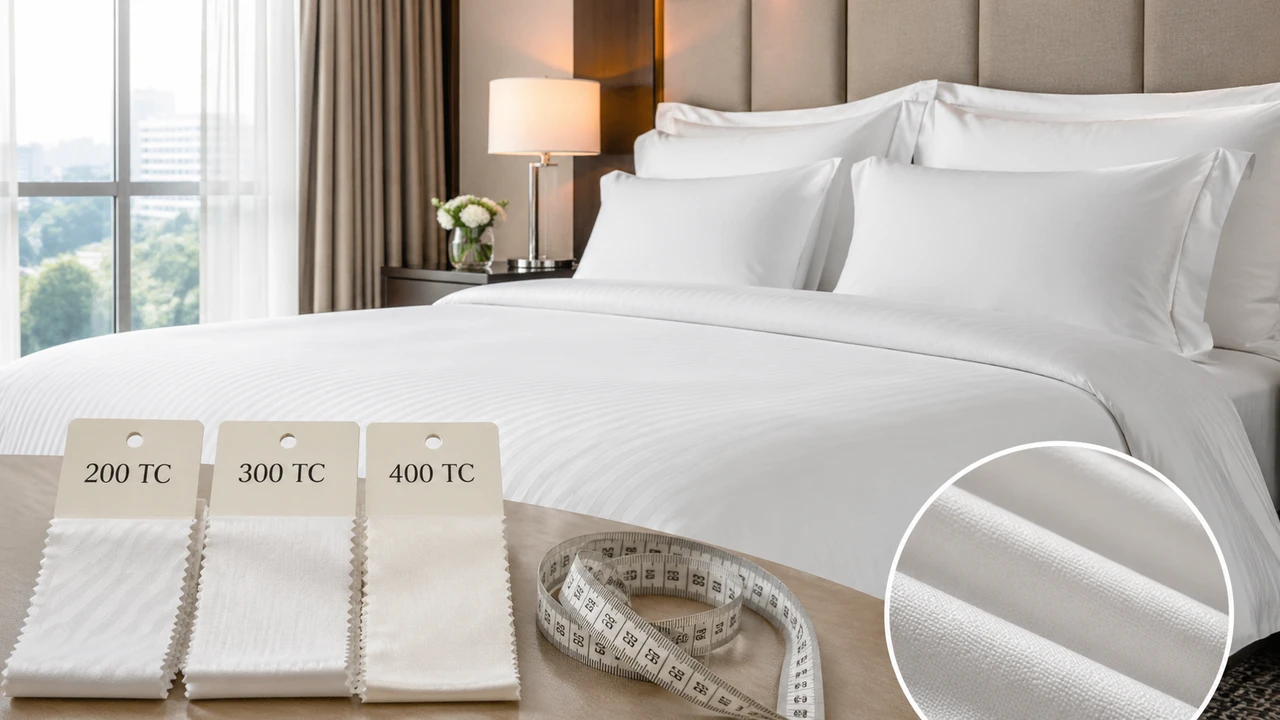
What Thread Count Is Best for Hotel Sheets? Complete Guide
Learn what thread count actually means, what most hotels buy, and how to choose the right sheets for durability, guest comfort, and budget.
If you are buying sheets for a hotel, the best thread count is usually not the highest number on the label. For most properties, the sweet spot falls between 200 and 300 thread count. That range usually gives you the best balance of guest comfort, durability, laundry performance, and replacement cost.
Luxury properties may move into the 300 to 400 thread count range, especially when they want a softer hand or a more refined sateen finish. But thread count alone does not determine quality. Fiber type, weave, yarn construction, and finishing all matter.
- Best overall range for most hotels: 200–300 thread count
- Best luxury-feel range: 300–400 thread count
- Best economy / high-turnover range: T-180 to T-200
- Most important buying lesson: do not buy by thread count alone
Shop Hotel Sheets by Thread Count
If you want to compare real hospitality options, start with our full collection of hotel bed sheets. For budget-conscious and easy-care programs, consider our T-180 sheets. For dependable everyday performance, explore 1888 Mills Suite Touch T-200 sheets. If you want a more refined striped presentation, see Thomaston Mills Royal Suite T-250 Woven Stripe. For a softer, more upscale feel, shop Martex Five Star T-300 bedding. You can also browse matching fitted sheets and flat sheets to complete your bedding program.
Executive Summary
The short answer: most hotels do best with sheets in the 200–300 thread count range. That is where value, durability, housekeeping efficiency, and guest comfort most often meet.
Higher thread count does not automatically mean better sheets. A well-made T-200 or T-250 sheet can outperform a weak T-300 or inflated-count sheet if the cotton, weave, and finishing are better suited to hospitality use.
Luxury programs often move into the 300–400 thread count range, but that works best when the fabric also uses better yarns, better finishing, and the right weave for the guest experience the property wants to create.
What Thread Count Actually Means
Thread count is the total number of threads woven into one square inch of fabric. In simple terms, it adds together the vertical threads and the horizontal threads. That makes it a real construction metric, but not a complete quality metric.
Two sheets can have the same thread count and still feel very different. One may be crisp and cool, while the other may feel smoother and denser. One may hold up well in a commercial laundry environment, while the other may shrink, pill, or wear out more quickly.
That is because thread count does not tell you everything. It does not fully explain the fiber quality, staple length, weave, finish, or whether the yarn is built for durability. In hospitality, those details matter just as much as the number itself.
Why Hotels Do Not Buy by Thread Count Alone
1. Fiber Quality Matters
Longer-staple cotton can produce finer, smoother yarns. That can improve softness and overall fabric quality without needing an inflated thread-count number. In other words, better cotton often beats a bigger label claim.
2. Weave Changes the Feel
Percale usually feels crisper, cooler, and more breathable. That makes it a practical choice for many hotels, especially in warm climates or anywhere guests prefer a classic “fresh hotel sheet” feel.
Sateen usually feels smoother, silkier, and more luxurious. It can work very well in upscale rooms, suites, and premium bedding programs, but it may not always be the best choice for the heaviest laundry environments.
3. Finishing Changes Performance
Mercerization, singeing, and shrinkage-control finishing can make a big difference in how sheets look, feel, and wear over time. These are not small details. In hospitality, finishing can affect wrinkle resistance, pilling, dimensional stability, and overall service life.
4. Laundry Performance Is Critical
Hotels do not evaluate sheets the way a homeowner does. They evaluate them after repeated wash, dry, fold, remake, and replacement cycles. That is why durability, shrinkage, and pilling often matter just as much as softness.
What Most Hotels Actually Buy
Most hotels do not chase the highest thread count possible. Instead, they buy according to service model, room rate, guest expectations, and laundry demands.
| Hotel type | Typical range | Why it works |
|---|---|---|
| Economy / budget | T-180 to T-200 | Helps control costs, supports easy laundering, and performs well in high-turnover rooms. |
| Midscale / general-purpose | T-200 to T-250 | Provides a strong balance of comfort, durability, and housekeeping efficiency. |
| Upscale | T-250 to T-300 | Offers a softer hand and more refined presentation without going too far into fragile luxury territory. |
| Luxury | 300 to 400 thread count | Supports a more premium hand feel when paired with high-quality cotton and the right weave. |
The key takeaway is simple: the best hotel sheets are usually the ones that fit the operation, not the ones with the highest number printed on the package.
Recommended Thread Count Bands by Hotel Goal
Best by use case
- T-180: best for economy programs, labor-sensitive operations, and easy-care performance
- T-200: one of the safest all-around hospitality choices for value and durability
- T-250: a smart middle ground when you want a more refined look and feel
- T-300: ideal for many upscale rooms and premium guest experiences
- 300–400: strongest range for luxury-feel bedding when the cotton and weave quality support it
Quick buying logic
- Choose percale for crispness, cooling, and broad guest appeal.
- Choose sateen for softness, drape, and a more luxurious presentation.
- Choose lower-count blends when durability and operational efficiency matter most.
- Compare fitted sheets and flat sheets separately when building a full bedding program.
Best Options by Thread Count
T-180: Best for Budget-Friendly, Easy-Care Programs
If your priority is value, operational efficiency, and a sheet that can handle repeated use, Oxford Super Blend T-180 sheets are a strong fit. This range makes sense for economy hotels, high-turnover rooms, and programs where speed and ease of care matter most.
T-200: Best Overall Value for Many Hotels
Suite Touch by 1888 Mills is a strong example of why T-200 remains one of the safest choices in hospitality. It gives many properties the right mix of durability, comfort, and cost control without overreaching.
T-250: Best Middle Ground for Presentation and Performance
T-250 Royal Suite by Thomaston Mills Woven Stripe sits in a useful middle band. It can look more refined than entry-level sheeting while still supporting a practical hotel bedding program.
T-300: Best for Softer Upscale Comfort
Martex Five Star T-300 bedding is a strong option when you want a softer hand and a more upscale impression. For many full-service and premium-room environments, T-300 is where hospitality comfort and perceived luxury begin to feel more elevated.
What Hotels Should Consider Before Buying
- Laundry intensity: how often will these sheets be washed, dried, and remade?
- Room type: standard rooms, suites, and premium rooms may justify different sheet programs.
- Guest feel: do you want crisp and cool, or soft and smooth?
- Fabric blend: blends may offer better wrinkle control and longer service life.
- Shrinkage and pilling: hospitality use magnifies these issues quickly.
- Replacement cycle: the best value is not always the lowest upfront price.
That is why many properties build their sheet program around total cost of ownership, not just first cost. A sheet that lasts longer and launders better can easily be the smarter buy, even if it is not the cheapest on day one.
Common Myths About Hotel Sheet Thread Count
- Myth: Higher thread count always means better sheets.
Reality: quality depends on much more than count alone. - Myth: Luxury always means ultra-high thread count.
Reality: many luxury-feel programs work well in the 300–400 range. - Myth: Thread count tells you how durable a sheet will be.
Reality: weave, yarn quality, finishing, and laundering conditions matter just as much. - Myth: Every property should buy the softest sheet possible.
Reality: operational needs often make a more balanced sheet the better long-term choice.
Frequently Asked Questions
What thread count do most hotels use?
Most hotels buy sheets in the 200–300 thread count range because that is where comfort, durability, and housekeeping performance often balance out best.
Is T-300 better than T-200 for hotels?
Not always. T-300 can feel softer or more upscale, but a strong T-200 sheet can be the better choice for properties that need long service life and better operational value.
What is the best thread count for budget hotels?
For many budget hotels, T-180 or T-200 is the most practical choice. These ranges are easier to maintain and usually make better sense for high-turnover use.
What is the best thread count for upscale hotels?
T-250 to T-300 is often a strong fit for upscale properties. It gives you a more refined feel without automatically sacrificing performance.
Should I choose fitted sheets and flat sheets separately?
Yes, many hotels do. Mattress depth, housekeeping preferences, and replacement patterns often make it smarter to compare fitted sheets and flat sheets separately.
Do luxury hotels always use the highest thread count possible?
No. Many luxury properties focus on better cotton, better weave, and better finishing rather than simply chasing the biggest thread-count number.
Final Answer: What Thread Count Is Best for Hotel Sheets?
For most hotels, the best thread count is 200 to 300. That range gives the best overall balance of guest comfort, durability, and operational performance. Properties that want a more premium look and feel may move into the 300 to 400 range, but only when the rest of the fabric quality supports it.
The smartest way to buy hotel sheets is not to chase the highest number. It is to choose the right construction for your property, your laundry environment, and your guest experience.
Need Help Choosing the Right Hotel Sheets?
Hotels4Humanity can help you compare the best options by performance, feel, and budget. Shop our full range of hotel bed sheets, including fitted sheets, flat sheets, T-180 sheets, T-200 sheets, T-250 sheets, and T-300 sheets to build the right bedding program for your property.